Cervicogenic Headache
You have regular headaches that seem to start in your neck. They often feel one-sided, steady, and worse with certain head or neck positions. You've seen multiple specialists, but your MRI looks relatively normal. You're wondering: Can neck problems really cause headaches?
The answer is yes. Cervicogenic headaches—headaches that originate from neck structures—are more common than many patients and even doctors realize. They account for 15-20% of chronic headaches but are frequently overlooked or attributed to other causes.
This page explains what cervicogenic headaches are, how neck problems cause head pain, why your imaging might look normal despite significant symptoms, and what treatment options can actually help.
What Is a Cervicogenic Headache?
A cervicogenic headache is pain that originates from structures in the neck but is felt in the head. It's a referred pain pattern—your brain interprets pain signals from irritated neck structures as head pain.
Typical characteristics include:
- Headache typically on one side of the head
- Pain that starts at the base of the skull and radiates toward the forehead, temple, or eye
- Steady pain (not throbbing)
- Headache worsens with certain neck positions or movements
- Often accompanied by neck pain or stiffness
- No nausea or light sensitivity (distinguishing it from migraine)
Cervicogenic headaches develop when structures in the neck irritate nerves—particularly the occipital nerves and upper cervical nerves—that travel toward the head.
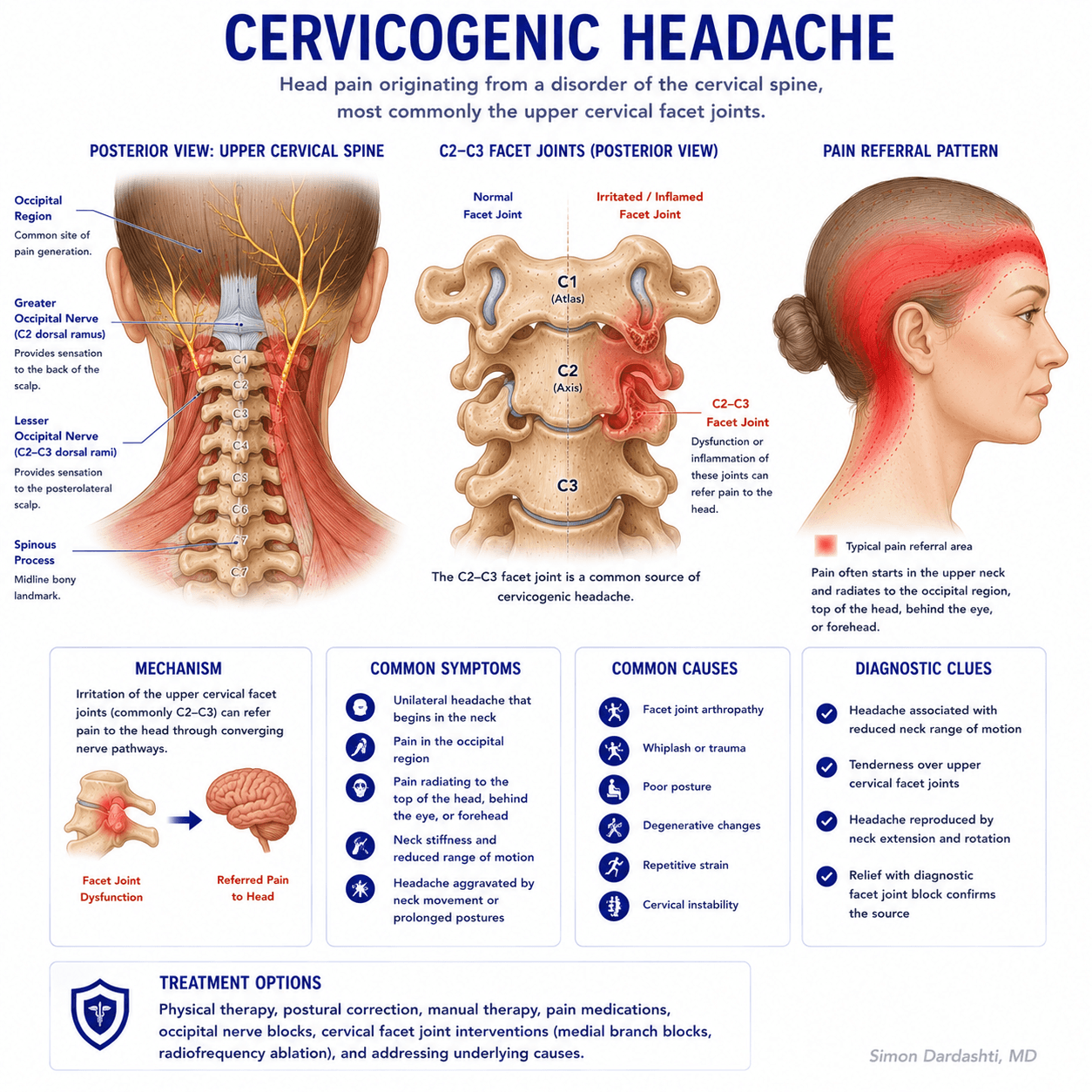
How Neck Structures Can Cause Head Pain
Several neck structures can irritate nerves and trigger cervicogenic headaches:
Cervical Facet Joints
The small joints connecting cervical vertebrae (especially at C2-C3 and C3-C4) can develop arthritis or irritation. When inflamed, these joints irritate nearby nerves, triggering referred pain into the head.
Cervical Nerve Roots
Upper cervical nerve roots (C2, C3) can be irritated by disc bulges, bone spurs, muscle tightness, or inflammation. This irritation sends pain signals that the brain interprets as head pain, often at the back of the head.
Neck Muscles
Chronically tight neck muscles can irritate nerves and trigger referred headaches. Poor posture, prolonged forward head position, stress, and injury all contribute to muscle tension that causes cervicogenic headaches.
Occipital Nerves
Occipital nerves pass through the neck on their way to the back of the scalp. When irritated by muscle tension, joint arthritis, or nerve compression, they produce characteristic headaches at the back of the head.
The key point: all of these are separate from migraine or tension headaches that originate in the brain itself.
Common Symptoms
If you have cervicogenic headaches, you likely recognize this pattern:
- Pain location: Usually one-sided, at the back of the head, and often radiating toward the temple, eye, or forehead
- Pain character: Steady, dull, or aching (not pulsing)
- Triggers: Certain neck movements, poor posture, prolonged sitting, or sustained neck positions
- Associated neck symptoms: Neck pain, stiffness, limited range of motion
- Duration: Variable—can be intermittent or chronic
- Medication response: May not respond well to typical migraine medications
Some patients also report a clicking or cracking sensation in the neck with movement, which is often related to facet joint irritation.
How Cervicogenic Headache Differs From Migraine
Many patients with cervicogenic headaches have been told they have migraines. While the conditions can coexist, they differ significantly:
| Feature | Cervicogenic | Migraine |
|---|---|---|
| Origin | Neck structures | Brain |
| One-sided | Typically yes | Often, but not always |
| Quality | Steady, aching | Throbbing, pulsing |
| Worse with neck movement | Yes | No |
| Nausea/light sensitivity | Usually absent | Often present |
| Neck pain/stiffness | Often present | Absent |
Important: Some people have both cervicogenic headaches and migraines. Proper diagnosis helps determine which is which so treatment can be targeted appropriately.
Why Imaging May Be Normal
This is one of the most frustrating aspects of cervicogenic headaches: your MRI can look completely normal while you have significant, disabling headaches.
Why? Because many causes of cervicogenic headaches don't show up on standard imaging:
- Small facet joint irritation: Minor joint inflammation or arthritis can cause significant pain without obvious MRI findings
- Muscle tension: Chronically tight muscles irritate nerves but don't appear abnormal on imaging
- Nerve irritation: A nerve can be irritated and causing pain without visible compression on MRI
- Subtle disc changes: Small disc bulges or degenerative changes that irritate nerves may not be obvious
Pain without clear imaging findings is actually quite common in cervicogenic headaches. This is why clinical evaluation—your history, physical exam, and response to diagnostic tests—is more important than imaging for diagnosis.
When imaging helps: If your cervicogenic headaches started after an accident or if symptoms have worsened significantly, imaging is useful to rule out major structural problems or injury.
How I Evaluate Cervicogenic Headache
Evaluating cervicogenic headaches requires a careful approach:
1. Detailed Headache History
When do headaches occur? What triggers them? Do certain neck positions or movements make them worse? Is neck pain present? This history is crucial for cervicogenic headache.
2. Physical Examination
I examine your neck range of motion, muscle tenderness, and whether specific movements reproduce your headache. This exam helps identify which neck structures are involved.
3. Imaging Review
If imaging exists, I review it to check for significant structural problems. But normal imaging doesn't rule out cervicogenic headache.
4. Diagnostic Injections
Strategic injections to cervical facet joints or occipital nerves confirm which neck structures are causing your headache and help guide treatment.
The goal is to identify specifically which neck structures are responsible so treatment can be targeted appropriately.
Common Treatment Options
Physical Therapy
Specialized neck physical therapy addressing posture, flexibility, and strength is often the first-line treatment. Exercises that improve cervical stability and reduce muscle tension frequently help cervicogenic headaches. Many patients improve significantly with therapy alone.
Activity Modification
Identifying activities that trigger headaches and modifying them helps. This often includes ergonomic adjustments (desk setup, phone position), taking breaks from prolonged postures, and avoiding movements that worsen headaches.
Medications
Depending on your situation, medications may help: muscle relaxants for neck tension, non-steroidal anti-inflammatories for inflammation, or other options. Migraine medications often don't help cervicogenic headaches, which is an important clue to diagnosis.
Occipital Nerve Blocks
Occipital nerve blocks deliver numbing medication around nerves at the back of the head. If this provides significant relief, it confirms that occipital nerve irritation (from neck structures) is causing your headache. The block provides temporary relief and helps identify if longer-term treatments might help.
Medial Branch Blocks
Medial branch blocks anesthetize nerves that supply cervical facet joints. If your cervicogenic headache is caused by facet joint arthritis, this block will provide relief and suggest that radiofrequency ablation might provide longer-lasting benefit.
Radiofrequency Ablation
Radiofrequency ablation uses heat to reduce pain signals from cervical joints and nerves. It's considered after diagnostic injections have identified which structures are responsible. Relief can last several months to a year or longer.
When Additional Evaluation Is Needed
Most cervicogenic headaches respond well to the approaches above. However, some situations warrant additional investigation:
- Sudden change in headache pattern: If your headaches suddenly worsen or change character, additional imaging may be needed
- Progressive neurological symptoms: Weakness, numbness, or other progressive nerve symptoms may indicate structural problems requiring further evaluation
- Headaches following trauma: Headaches that started after accidents or injuries should be evaluated for structural injury
- Not responding to conservative care: If you've tried physical therapy and activity modification without improvement, diagnostic injections can identify specific structures responsible
In these situations, working with both your primary doctor and a pain specialist ensures comprehensive evaluation.
About Simon Dardashti, MD
Board-Certified Pain Medicine Physician
- • Specialized training in Pain Medicine from UCLA
- • 10+ years diagnosing and treating cervicogenic headaches
- • Expert in occipital nerve blocks and cervical medial branch procedures
- • Focus on identifying specific neck structures causing headaches
- • Virtual consultations available
Evaluate Your Cervicogenic Headache
If you suspect your headaches originate from your neck—or if you have regular headaches that haven't improved despite seeing multiple specialists—a comprehensive evaluation can identify specifically which neck structures are involved and what treatment might help.
Schedule a Virtual ConsultationVirtual consultations allow me to discuss your headache pattern and explore whether a neck source might be responsible.
Frequently Asked Questions
If I have cervicogenic headaches, will they ever go away completely?
Many patients experience significant improvement or even resolution with appropriate treatment. Physical therapy, activity modification, and proper posture help many people long-term. Others benefit from procedural interventions. The key is identifying that the neck is the source and addressing it specifically.
Can poor posture cause cervicogenic headaches?
Yes. Prolonged forward head position and poor posture create muscle tension and alter cervical alignment, irritating nerves. Even if posture is not the original cause, correcting posture is usually an important part of treatment.
Are cervicogenic headaches dangerous or can they lead to worse conditions?
Cervicogenic headaches themselves are not dangerous, though they can significantly impact quality of life. The underlying neck problems causing them should be addressed, but the headaches won't cause damage if left untreated. However, proper evaluation ensures no other serious conditions are missed.
Can stress or tension in my neck cause cervicogenic headaches?
Absolutely. Emotional stress often manifests as muscle tension in the neck and shoulders. This tension irritates nerves and can trigger cervicogenic headaches. Stress management, relaxation techniques, and stretching can help address this component.
How long should I try physical therapy before considering other treatments?
Physical therapy typically shows results within 6-8 weeks if it will work. If you've been in therapy for 8-12 weeks without meaningful improvement, diagnostic injections can identify whether a specific neck structure (facet joint or nerve) is causing your headache and whether procedures might help.
Related Resources
- Pain Without Imaging Findings — Understanding pain when imaging looks normal
- Treatment Options — Overview of conservative, procedural, and other approaches
- Neck Pain — Comprehensive guide to neck pain
- Cervical Radiculopathy — Nerve root irritation in the neck
- Occipital Neuralgia — Irritation of occipital nerves
- Occipital Nerve Blocks — Diagnostic and therapeutic nerve blocks
- Medial Branch Blocks — Facet joint targeted injections
- Virtual Consultations — Schedule an appointment
Medical Disclaimer: This page is educational and does not constitute medical advice. Information presented here is based on current evidence and clinical experience but does not replace evaluation by a healthcare provider. All medical decisions should be made in consultation with a qualified physician who understands your complete medical history. If you have persistent headaches, seek evaluation from a qualified healthcare provider.