Procedures & Treatment Options
Facet Joint Injections
& Medial Branch Blocks.
Facet joint injections and medial branch blocks are image-guided procedures used to evaluate — and sometimes treat — pain that may be coming from the small joints along the back of the spine. A formal clinical evaluation is required to determine whether either procedure is appropriate for an individual patient.
In Brief
Facet-Mediated Pain
Facet joint injections and medial branch blocks are used to evaluate and sometimes treat pain that may be coming from the small joints along the back of the spine.
Diagnostic and Therapeutic
A medial branch block is primarily a diagnostic test. A facet joint injection may serve both a diagnostic and a therapeutic purpose, depending on the clinical situation.
May Inform Next Steps
A meaningful response to medial branch blocks can help guide whether a patient may later be considered for radiofrequency ablation of the medial branch nerves.
Overview
Facet Joints and Medial Branch Nerves.
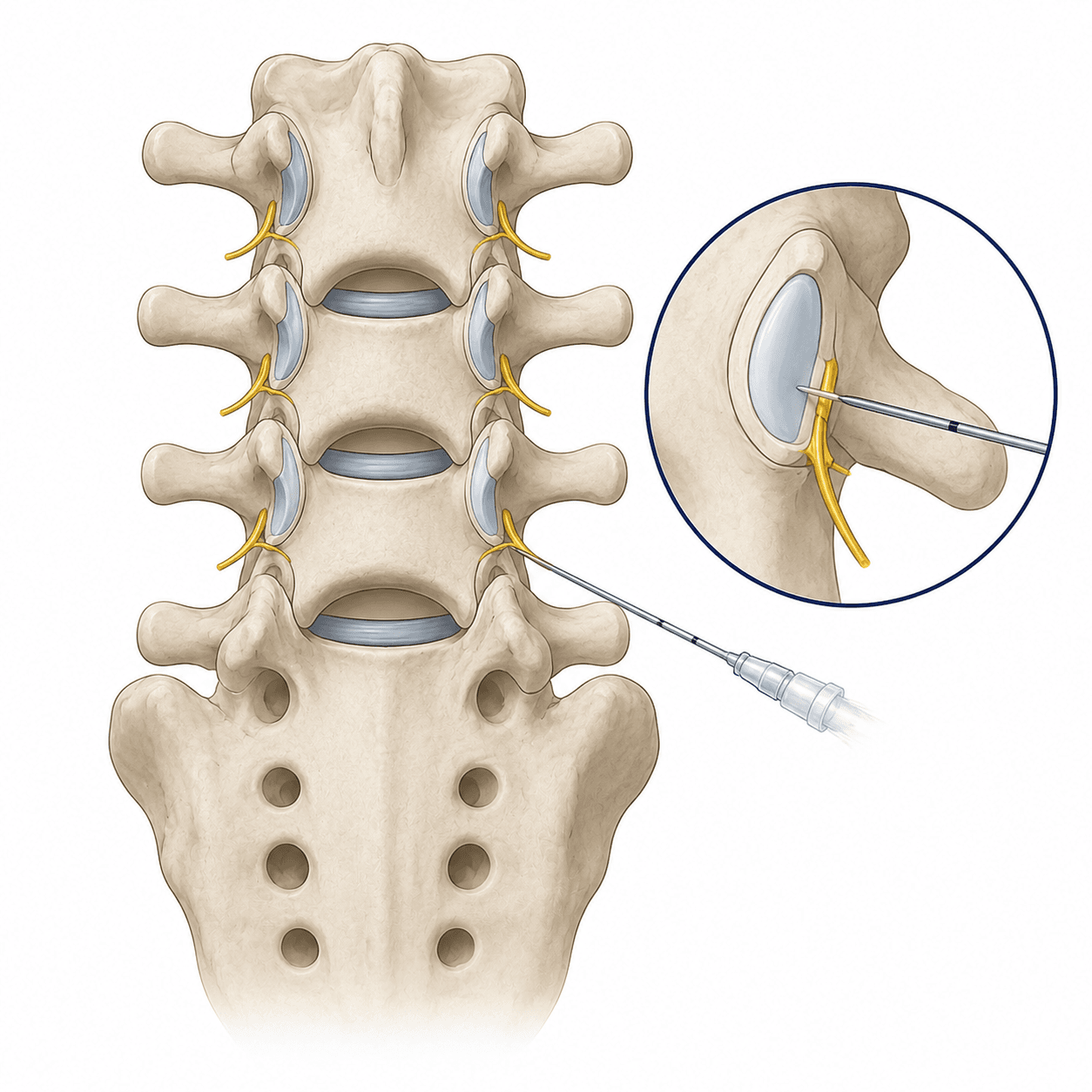
Facet joints — also called zygapophyseal joints — are small paired joints located along the back of the spine at many spinal levels. They help guide spinal motion and provide stability. Like other joints in the body, facet joints can become painful due to arthritis, inflammation, injury, or degenerative changes over time.
The medial branch nerves are small nerves that carry pain signals from the facet joints to the brain. Because these nerves follow a consistent anatomical course, they can be targeted with injections for both diagnostic and therapeutic purposes.
Facet joint injections and medial branch blocks are related procedures that approach this pain from slightly different angles. Both are performed under imaging guidance and are part of a broader evaluation and treatment strategy for spine pain that may involve the facet joints.
Conditions
When May These Procedures Be Considered?
These procedures may be considered for patients with neck pain, mid-back pain, or low back pain when the facet joints are suspected to be contributing to symptoms. Facet-mediated pain often presents as axial spine pain — pain felt in the neck or back itself rather than traveling down the arm or leg — though referred pain patterns can occur.
Symptoms that may suggest facet joint involvement include pain that is worsened by extension, rotation, prolonged standing, or certain movements. Pain may also be aggravated by rising from a seated position or maintaining a static posture for extended periods.
Conditions for which facet joint injections or medial branch blocks may be evaluated include:
- Cervical facet pain (neck pain of possible facet origin)
- Thoracic facet pain (mid-back pain of possible facet origin)
- Lumbar facet pain (low back pain of possible facet origin)
- Arthritis-related spine pain involving the facet joints
- Mechanical neck or back pain not explained by disc or nerve root pathology
- Pain following whiplash or other spine injury
- Axial spine pain that has not responded adequately to conservative care
Imaging findings alone do not diagnose facet-mediated pain. Clinical history and physical examination are essential parts of the evaluation.
Procedure Types
Facet Joint Injection vs. Medial Branch Block.
Facet Joint Injection
A facet joint injection places medication — typically local anesthetic and sometimes a corticosteroid — directly into or near the facet joint capsule. It may serve a diagnostic purpose by helping to determine whether the joint is a significant pain source, and it may also provide temporary therapeutic relief if inflammation is present.
Medial Branch Block
A medial branch block places local anesthetic near the small medial branch nerves that carry pain signals from the facet joints. It is primarily used as a diagnostic test: by temporarily numbing these nerves, the procedure helps determine whether the facet joints are a likely contributor to the patient's pain. Temporary pain relief may occur during the block period, but the medial branch block itself is not intended as a long-term therapeutic treatment.
Connection to Radiofrequency Ablation
If medial branch blocks provide significant temporary relief, a patient may later be considered for radiofrequency ablation of the medial branch nerves — a procedure that uses heat energy to interrupt pain signaling on a longer-term basis. This decision depends on the full clinical picture, the degree of response, and other patient factors.
The Procedure
What Happens During the Procedure?
The procedure is typically performed with the patient lying on an imaging table. The skin over the injection site is cleaned and numbed with local anesthetic. Using fluoroscopic (X-ray) guidance, a small needle is carefully guided to the target area — either the facet joint or the medial branch nerve.
Contrast dye may be injected to confirm that the needle is properly positioned before medication is delivered. The medication is then injected through the needle. Patients may feel pressure or brief discomfort during the procedure. The injection itself is typically completed within a few minutes per target level, though the full procedure time varies based on the number of levels being treated.
What to Expect Afterward.
Some patients experience temporary soreness at the injection site following the procedure. Pain relief, if it occurs, may be noticeable within the first hour or two from the local anesthetic component. If a corticosteroid was included, any additional anti-inflammatory effect may develop over the following days.
For a medial branch block, record the degree and timing of pain relief, activity during assessment, and any sedation or other medication as instructed. These findings are interpreted together with the technique and clinical picture; relief alone does not prove the diagnosis or guarantee RFA benefit.
Risks & Context
Risks and Considerations.
As with any procedure, facet joint injections and medial branch blocks carry potential risks. Serious complications are uncommon but may include temporary soreness or bruising at the injection site, bleeding, infection, allergic reaction to the injected medication, temporary numbness or weakness in the treated area, worsening of pain, or lack of meaningful relief.
Dr. Dardashti reviews each patient's medical history, medications, imaging, and symptoms before recommending a procedure. Risks, expected benefits, and realistic outcomes are discussed as part of the pre-procedure evaluation.
How This Fits Into a Treatment Plan.
Facet joint injections and medial branch blocks are rarely a standalone solution. They are most useful as part of a broader pain management plan that may also include physical therapy, home exercise programs, activity modification, and medications when clinically appropriate.
When medial branch blocks support a significant facet joint contribution to a patient's pain, radiofrequency ablation may be considered as a next step for selected patients. The goal is to find the combination of treatments most likely to improve function and reduce pain based on each patient's individual clinical situation.
An evaluation can help determine whether facet-related pain may be contributing to your symptoms and whether an injection-based approach is appropriate for your clinical situation.
FAQ
Frequently Asked Questions.
Are facet joint injections and medial branch blocks the same thing?
They are related but not identical. A facet joint injection places medication directly into or near the joint itself. A medial branch block places local anesthetic near the small nerves that carry pain signals from the joint. Both are used to evaluate facet-related pain, but they target slightly different structures.
How long does the procedure take?
The procedure itself is typically brief — often fifteen to thirty minutes or less, depending on the number of levels treated. Patients generally spend additional time in observation before discharge.
Will I be asleep during the procedure?
Diagnostic medial branch blocks are generally performed without routine sedation because sedation can affect interpretation of the response. Individual circumstances may justify it. Discuss the plan with your physician and follow the specific preparation and discharge instructions.
How soon will I know if it helped?
With a medial branch block, any pain relief from the local anesthetic is usually noticeable within the first hour or two after the procedure. Patients may be asked to track their pain levels and activities during this window to help assess the response.
What does it mean if a medial branch block works?
Significant temporary relief following a medial branch block suggests that the targeted nerves are contributing to the patient's pain. This finding can help support — though not confirm — a diagnosis of facet-mediated pain and may inform future treatment decisions, including whether radiofrequency ablation is appropriate.
Can this lead to radiofrequency ablation?
It can, in appropriate patients. Radiofrequency ablation of the medial branch nerves may be considered when a patient has a meaningful response to diagnostic medial branch blocks and meets other clinical criteria. The decision depends on the full clinical picture.
Are these procedures appropriate for all back or neck pain?
No. Facet joint injections and medial branch blocks are most likely to be appropriate when the clinical evaluation suggests that the facet joints may be a significant source of pain. They are not the right choice for every type of spine pain and are not recommended without a formal clinical evaluation.
Limitations
Important Limitations.
Facet joint injections and medial branch blocks do not treat underlying degenerative changes in the spine and are not a cure for arthritis or structural spinal conditions. Response varies among patients. Some patients experience meaningful temporary relief; others may experience partial benefit or no relief.
A formal clinical evaluation is required to determine whether either procedure is appropriate for an individual patient. This page is for general informational purposes only and does not constitute medical advice or a guarantee of any specific outcome.
Dr. Dardashti sees patients in Mission Hills, California, serving patients from the San Fernando Valley, Santa Clarita Valley, and surrounding Los Angeles communities.
Related
Medically Reviewed by Simon Dardashti, MD, MS·Board-Certified, Pain Medicine & Anesthesiology
Last Reviewed: July 2026
Interpreting results and questions to ask
Selection for radiofrequency ablation depends on the spinal region, diagnosis, technique, and documented block response. Clinical guidelines and coverage policies can use different protocols; a single block number or relief percentage should not be applied without context. A positive block does not guarantee successful ablation.
Ask about the assessment, whether sedation is needed, risks such as bleeding, infection or nerve injury, and the plan if treatment does not help. Sedation is not routinely used for diagnostic blocks because it can affect interpretation. Do not change medication on your own; follow the individual plan from your treating team.
Sources and scope
- Consensus practice guidelines on interventions for lumbar facet joint pain from a multispecialty, international working group
- Consensus practice guidelines on interventions for cervical spine (facet) joint pain from a multispecialty international working group
These sources support general education; they do not establish your diagnosis or replace individual assessment.