Procedures & Treatment Options
Radiofrequency
Ablation.
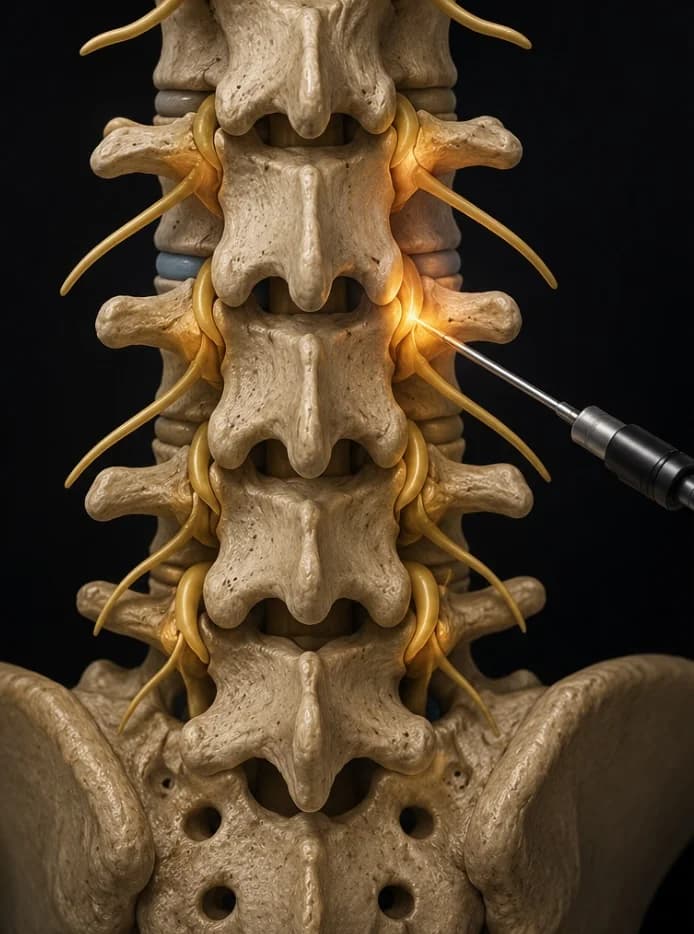
Radiofrequency ablation may be considered for selected patients with suspected facet-mediated spine pain. The procedure is performed after appropriate clinical evaluation and diagnostic nerve blocks support a possible facet joint contribution to the patient's pain.
In Brief
Facet-Mediated Pain
Radiofrequency ablation (RFA) is most commonly used for suspected facet-mediated spine pain in the cervical, thoracic, or lumbar regions.
Diagnostic Blocks First
Medial branch blocks are typically performed before RFA to help assess whether the facet joints contribute to the patient's pain.
Response Varies
RFA is not appropriate for every type of spine pain. Response varies, and the procedure should only be considered after appropriate clinical evaluation.
Overview
What Is Radiofrequency Ablation?
Radiofrequency ablation (RFA) is a procedure that uses heat generated by radiofrequency energy to disrupt the pain signals carried by specific nerves. For spine-related pain, RFA is most commonly applied to the medial branch nerves — small nerves that carry pain signals from the facet joints to the brain.
By interrupting these pain signals, RFA may provide relief for patients whose pain is primarily mediated by the facet joints. The procedure is performed under imaging guidance and is typically an outpatient procedure.
RFA does not treat the underlying degenerative changes in the spine and is not a permanent solution. The targeted nerves can regenerate over time, and symptoms may return. Repeat procedures may be considered in appropriate clinical circumstances.
Diagnostic Steps
Diagnostic Blocks Before RFA.
Before radiofrequency ablation is considered, diagnostic medial branch blocks are typically performed to determine whether the facet joints are a significant source of the patient's pain. A medial branch block is an injection of local anesthetic near the medial branch nerve, temporarily numbing the nerve to assess its contribution to the patient's symptoms.
A meaningful positive response to medial branch blocks — typically defined by a significant reduction in pain during the block period — helps support the rationale for considering RFA. The number of diagnostic blocks and criteria for a positive response are determined based on clinical guidelines and individual clinical context.
Patients who do not have an adequate response to diagnostic medial branch blocks are generally not considered appropriate candidates for RFA at that time.
Candidacy
When May Radiofrequency Ablation Be Considered?
RFA may be considered for selected patients who meet appropriate clinical criteria, including:
- Suspected facet-mediated pain in the cervical, thoracic, or lumbar spine
- Axial spine pain without dominant radicular symptoms
- Meaningful positive response to diagnostic medial branch blocks
- Pain that has not been adequately managed with conservative measures
- Clinical presentation consistent with facet joint involvement on evaluation
RFA is not appropriate for every type of spine pain and should only be considered after appropriate clinical evaluation and positive diagnostic block response.
Limitations
Important Limitations.
Radiofrequency ablation is not a cure for underlying degenerative spine conditions. Response to the procedure varies among patients. Some patients experience significant and lasting relief; others may experience partial or short-term benefit.
The procedure carries potential risks, which should be discussed with the treating physician before any procedure is performed. This page is for general informational purposes only and does not constitute medical advice or create a physician-patient relationship.
Dr. Dardashti sees patients in Mission Hills, California, serving patients from the San Fernando Valley, Santa Clarita Valley, and surrounding Los Angeles communities.
Medically Reviewed by Simon Dardashti, MD, MS·Board-Certified, Pain Medicine & Anesthesiology
Last Reviewed: July 2026
Interpreting results and questions to ask
Selection for radiofrequency ablation depends on the spinal region, diagnosis, technique, and documented block response. Clinical guidelines and coverage policies can use different protocols; a single block number or relief percentage should not be applied without context. A positive block does not guarantee successful ablation.
Ask about the assessment, whether sedation is needed, risks such as bleeding, infection or nerve injury, and the plan if treatment does not help. Sedation is not routinely used for diagnostic blocks because it can affect interpretation. Do not change medication on your own; follow the individual plan from your treating team.
Sources and scope
- Consensus practice guidelines on interventions for lumbar facet joint pain from a multispecialty, international working group
- Consensus practice guidelines on interventions for cervical spine (facet) joint pain from a multispecialty international working group
These sources support general education; they do not establish your diagnosis or replace individual assessment.