Procedures & Treatment Options
Sacroiliac Joint
Injections.
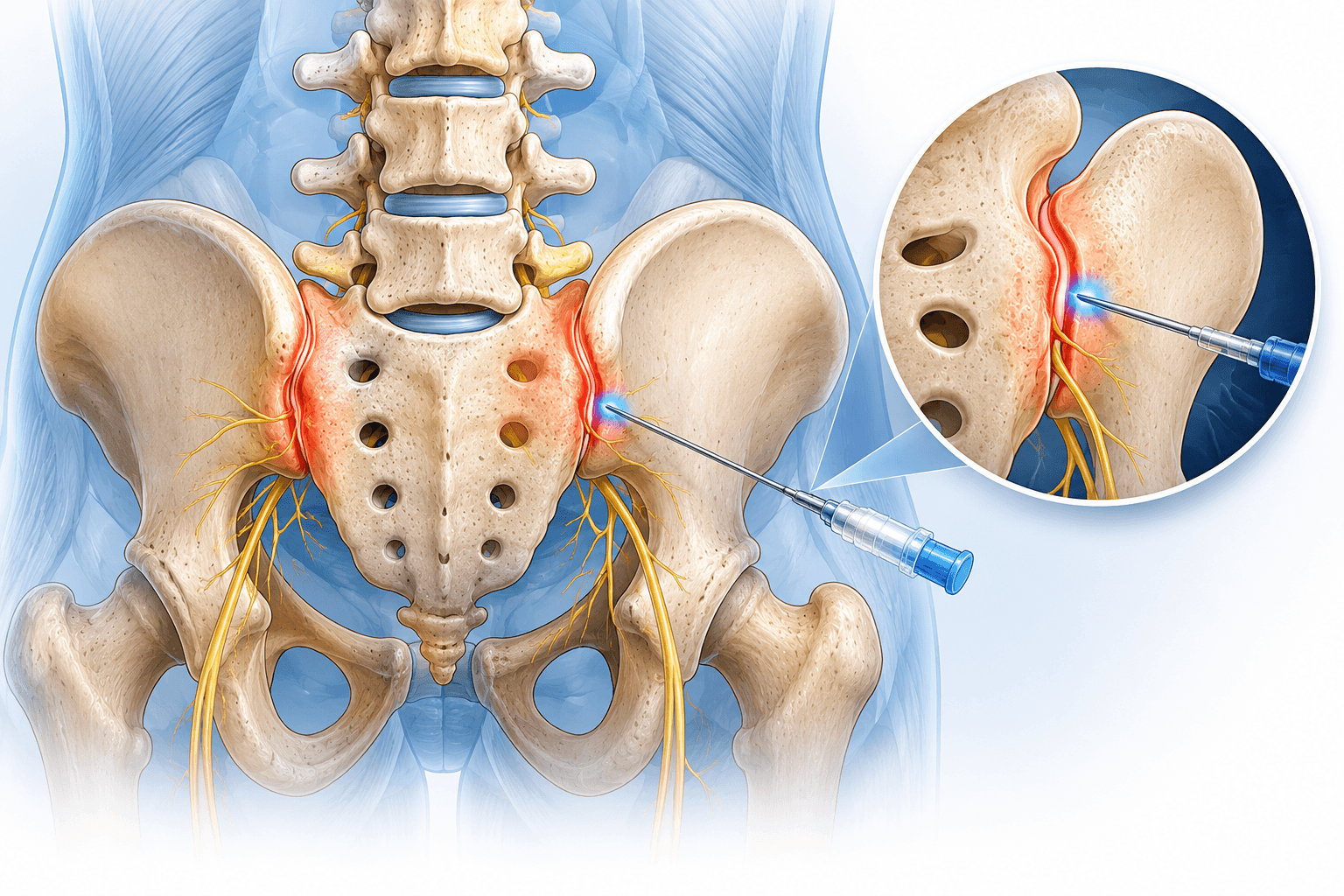
Sacroiliac joint injections are image-guided procedures that can help determine whether the SI joint is contributing to a patient's pain — and may also provide temporary relief. A formal clinical evaluation is needed to determine whether this procedure is appropriate.
In Brief
What it is
An image-guided injection into or around the sacroiliac joint to evaluate or treat lower back and buttock pain that may originate from this joint.
When it may help
In selected patients with lower back, buttock, or hip area pain where evaluation suggests the SI joint may be a source. Not appropriate for every patient.
What to expect
Performed with fluoroscopic image guidance. Local anesthetic numbs the skin beforehand. Patients are typically observed briefly and go home the same day.
Overview
What Is the Sacroiliac Joint?
The sacroiliac (SI) joints are located at the base of the spine, where the sacrum — the triangular bone between the lumbar spine and the tailbone — connects to the two iliac bones of the pelvis. There is one SI joint on each side.
The SI joints carry load between the upper body and the legs. They are supported by strong ligaments and muscles and allow relatively limited movement. Even so, they can become a source of pain in some individuals.
SI joint pain typically presents in the lower back and buttock region and may extend into the upper thigh. It can be difficult to distinguish from other causes of low back pain on the basis of symptoms alone.
Symptoms
Symptoms That May Suggest SI Joint Involvement.
No single symptom confirms that the SI joint is the source of pain. The following patterns are sometimes associated with SI joint pain — though overlap with other conditions is common:
- Lower back pain, often one-sided, near the top of the buttock
- Buttock, hip, or upper leg pain
- Pain that worsens with prolonged sitting or standing
- Pain with transitional movements such as rolling over in bed or getting up from a chair
- Tenderness over the sacroiliac region on one or both sides
These features alone are not diagnostic. A thorough clinical evaluation — including physical examination with specific provocation maneuvers, review of imaging when available, and consideration of the patient's response to treatment — is needed to assess whether the SI joint may be a meaningful source of pain.
Evaluation
Why This Procedure May Be Recommended.
Diagnosing SI joint pain with certainty is challenging. Physical examination findings and imaging are helpful but neither is definitive. An SI joint injection has two potential purposes:
Diagnostic
If the patient's typical pain is significantly reduced after local anesthetic is injected into the joint, this suggests the SI joint is contributing to the pain. This response can help guide further treatment decisions.
Therapeutic
An anti-inflammatory medication (corticosteroid) may be included alongside local anesthetic. This can provide temporary relief in some patients, though the response varies and cannot be predicted in advance.
The procedure is one part of an individualized treatment plan. Not all patients with suspected SI joint pain are candidates, and the decision is based on formal clinical evaluation.
The Procedure
What the Procedure Involves.
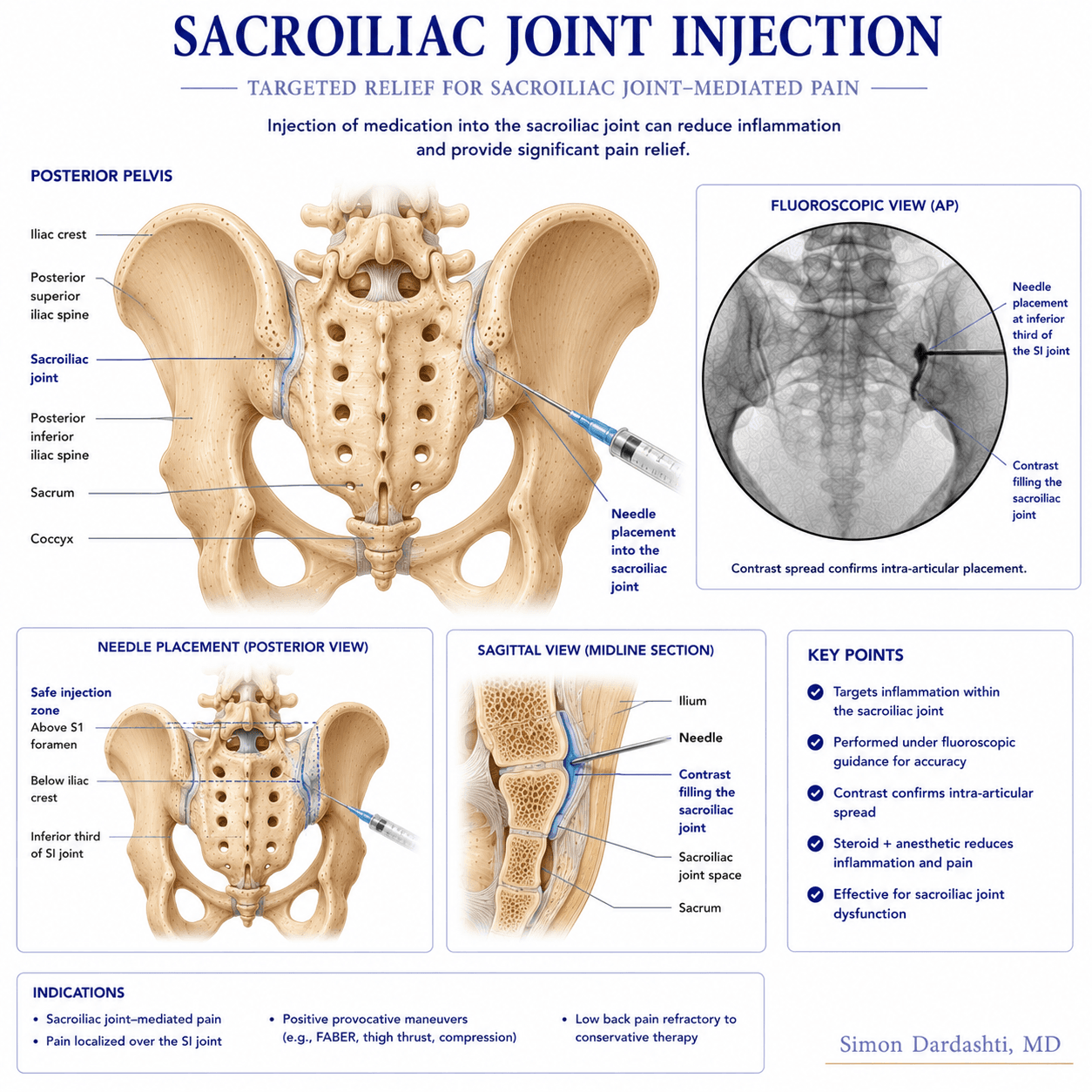
Sacroiliac joint injections are performed using real-time image guidance — typically fluoroscopy — to allow accurate needle placement into the joint space.
The patient lies face down on the procedure table. The skin over the targeted area is cleaned and numbed with local anesthetic. The needle is then guided into position under continuous imaging. Once placement is confirmed, the medication is delivered.
The procedure typically takes a short amount of time. Patients are monitored briefly afterward and usually go home the same day. A responsible adult should be available to drive the patient home.
Patients are often asked to note their pain levels in the hours following the procedure, particularly during activities that typically provoke their symptoms. This information can be useful diagnostically.
Aftercare
After the Procedure.
It is common to have some soreness at the injection site for a day or two following the procedure. A temporary increase in pain is also possible as the local anesthetic wears off.
Most patients are advised to take it easy for the remainder of the day and to avoid strenuous activity until clearance is given. Specific instructions are provided based on the individual clinical situation.
If a corticosteroid was used, any anti-inflammatory effect may take several days to develop. Patients are typically asked to report back on their response so that the result can be incorporated into the ongoing treatment plan.
Risks
Risks and Considerations.
Sacroiliac joint injections are generally well tolerated when performed following appropriate clinical evaluation. As with any procedure, there are risks to be aware of:
- Temporary increase in pain at the injection site
- Minor bleeding or bruising
- Infection (uncommon with proper technique)
- Temporary numbness or weakness in the leg (rare)
- Medication-related effects from corticosteroids, including temporary changes in blood sugar
- Incomplete or absent response to the injection
Risks and benefits are discussed with each patient before any procedure is performed. The appropriateness of the procedure depends on individual circumstances.
Treatment Plan
Part of a Broader Treatment Plan.
An SI joint injection is rarely the only element of treatment. Physical therapy, activity modification, and other conservative measures are often part of the overall plan. The results of the injection — including whether and how much pain was reduced — help guide next steps.
In selected patients who have had a meaningful diagnostic response and whose pain persists despite other measures, additional options may be considered. Treatment planning is individualized and based on the full clinical picture.
FAQ
How do I know if my pain is coming from the SI joint?
There is no single test that definitively identifies SI joint pain. Diagnosis is based on the pattern of symptoms, physical examination findings, and the patient's history. Pain in the lower back, buttock, or upper leg that worsens with prolonged standing or certain movements may warrant evaluation. A formal clinical assessment is the appropriate starting point.
What is the procedure like?
A sacroiliac joint injection is performed with image guidance — typically fluoroscopy — to confirm accurate needle placement into the joint. Local anesthetic is used to numb the skin before the needle is advanced. Most patients tolerate the procedure well and are observed briefly before going home.
Will I be sedated?
Most patients remain awake during the procedure. Light sedation may be offered in some settings, but general anesthesia is not typically required.
How quickly will I feel a difference?
When a local anesthetic is injected into the SI joint, any reduction in pain from that component is usually noticeable within the first hour or two. Patients may be asked to pay attention to their pain level during this early window, as the response can help inform the diagnostic evaluation.
How long does the relief last?
The duration of relief varies. Local anesthetic effects typically last a few hours. If a corticosteroid is also used, any anti-inflammatory benefit may persist for weeks or longer in some patients — though the response is not predictable and not guaranteed.
Can this procedure be repeated?
In appropriate patients, SI joint injections may be repeated if there has been a meaningful prior response and sufficient time has passed. The frequency and appropriateness of repeat procedures is determined during clinical evaluation.
Are there risks?
Like all injections, there are risks, including temporary increase in pain, bleeding, infection, or medication-related effects. Serious complications are uncommon. The risks and benefits are reviewed before any procedure.
Limitations
Important Limitations.
Not all patients with lower back or buttock pain are candidates for sacroiliac joint injections. Treatment recommendations are individualized and based on formal clinical evaluation. Response to the procedure varies and cannot be predicted in advance. This content is for general informational purposes only and does not constitute medical advice or a guarantee of any specific outcome.
Dr. Dardashti sees patients in Mission Hills, California, serving the San Fernando Valley, Santa Clarita Valley, and surrounding Los Angeles communities.
Medically Reviewed by Simon Dardashti, MD, MS·Board-Certified, Pain Medicine & Anesthesiology
Last Reviewed: July 2026