Procedures & Treatment Options
Botox for Chronic
Migraine Prevention.
Botox — the brand name for onabotulinumtoxinA — is an FDA-approved preventive treatment for chronic migraine in appropriately selected adults. Dr. Dardashti evaluates candidacy based on headache history, prior treatment, and individual clinical presentation.
In Brief
A Preventive Treatment
Botox (onabotulinumtoxinA) for chronic migraine is a preventive treatment given on a repeating schedule — it is not used to treat a migraine attack that is already underway.
For Chronic Migraine Specifically
This treatment is intended for adults with chronic migraine — generally 15 or more headache days per month, with migraine features on at least 8 of those days, for more than 3 months. It is not the same indication as episodic migraine.
Different From Cosmetic Botox
Medical Botox for migraine uses a different dosing pattern and different injection sites than cosmetic Botox, and is administered for a distinct medical purpose.
Overview
What Is Botox for Chronic Migraine?
Botox is the brand name for onabotulinumtoxinA, a purified protein derived from botulinum toxin. When used for chronic migraine prevention, it is administered according to an FDA-approved, standardized treatment protocol developed specifically for this condition.
Botox for chronic migraine is a preventive treatment — it is given on a recurring schedule with the goal of reducing headache frequency and burden over time. It is not an acute rescue treatment, and it will not stop a migraine that is already in progress.
This treatment is intended only for patients whose headache pattern meets the clinical definition of chronic migraine, following individualized evaluation.
Definition
What Qualifies as Chronic Migraine?
Chronic migraine is generally defined as headache occurring on 15 or more days per month, with migraine features present on at least 8 of those days, for more than 3 months, with evaluation for other headache causes and for medication-overuse headache, which may coexist with chronic migraine.
This is a distinct diagnosis from episodic migraine, which involves fewer headache days per month. Botox for chronic migraine is approved for the chronic form specifically — not every patient with frequent headaches has chronic migraine, and not every headache disorder is migraine. Establishing an accurate diagnosis is an important first step, and may involve ruling out other headache conditions such as cervicogenic headache.
Medical vs. Cosmetic
How Medical Botox Differs From Cosmetic Botox.
Although the medication is the same, Botox for chronic migraine differs from cosmetic Botox in purpose, dosing pattern, and treatment sites. Medical treatment for chronic migraine follows a standardized protocol targeting specific head and neck muscle regions associated with migraine, at doses established through clinical research for this indication.
This page describes medical treatment for chronic migraine prevention only. It does not describe or offer cosmetic Botox services.
Candidacy
Who May Be Considered.
Candidacy requires individualized evaluation. Factors that may be considered include:
- Headache frequency and duration, and whether the pattern fits chronic migraine rather than another headache disorder
- A headache diary or reliable headache history
- Prior preventive treatments tried and how the patient responded
- Acute-medication use, and the possibility of medication-overuse headache
- Pregnancy or breastfeeding status
- Any neuromuscular disorders
- Infection near a proposed injection site
- Prior botulinum-toxin exposure
- Current medications, including any that may affect neuromuscular transmission
- Individual insurance authorization criteria, which vary by plan
Insurance coverage criteria vary by insurer and are not guaranteed. A formal clinical evaluation is required to determine candidacy for any individual patient.
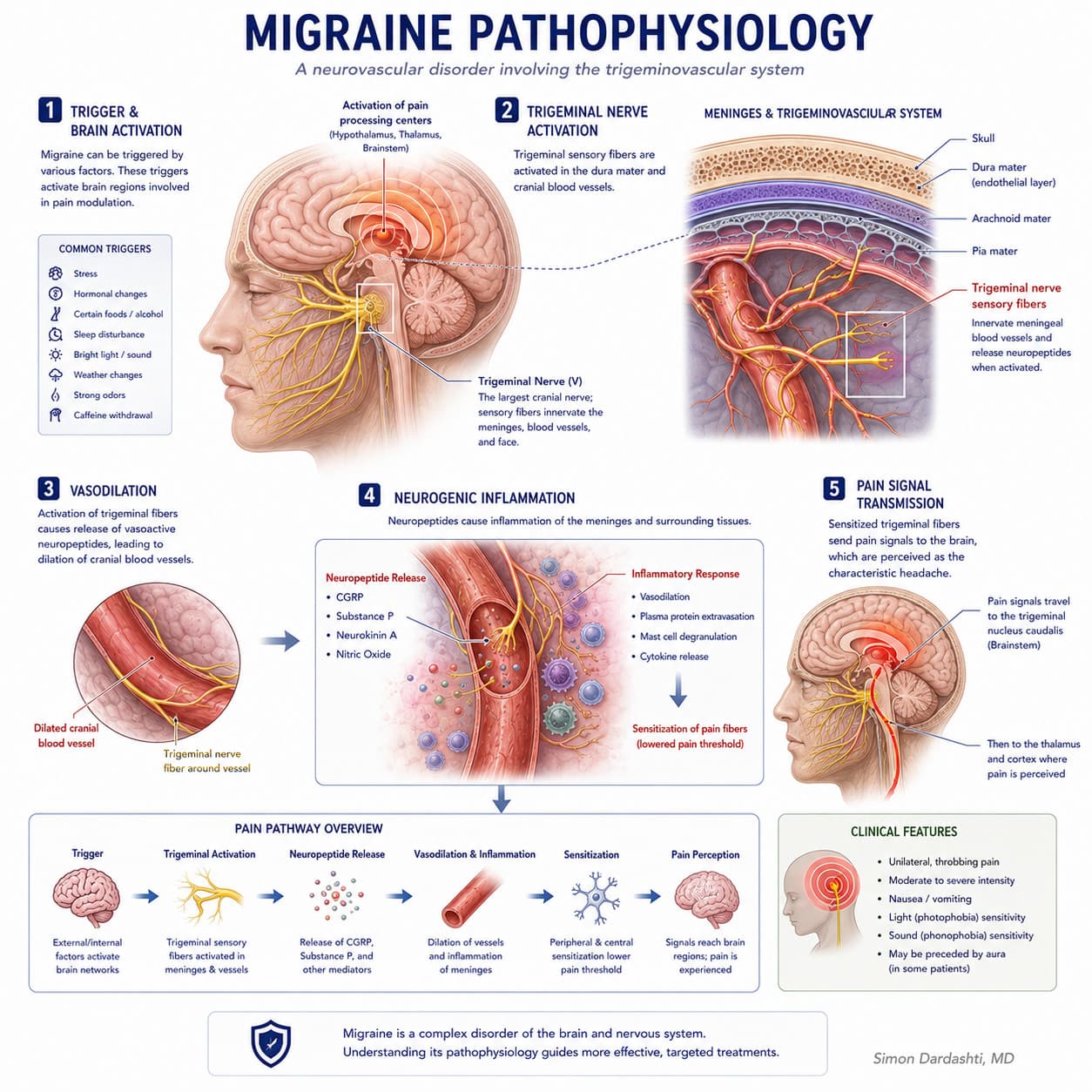
Mechanism
How the Treatment Works.
OnabotulinumtoxinA is thought to reduce chronic migraine symptoms by blocking the release of certain neurotransmitters involved in pain signaling, though the precise mechanism in migraine prevention is not completely understood. Effects build over the treatment cycle and are temporary, which is why treatment is repeated at intervals when clinically appropriate.
Procedure
What the Procedure Involves.
Treatment is generally performed in an outpatient setting. Small injections are administered across standardized regions of the head and neck. The labeled treatment pattern commonly used for chronic migraine involves 155 units divided among 31 injection sites across these regions.
Patients may feel brief pinching or pressure at each injection site. The visit itself is typically brief, and most patients resume normal activities the same day.
When clinically appropriate, treatment is commonly repeated at approximately 12-week intervals.
Timeline
Expected Timeline and Potential Benefits.
Response to treatment varies among patients. Some notice improvement after the first treatment cycle, while others may require more than one cycle before benefit can be meaningfully assessed. The general aim of treatment is to reduce headache burden — such as headache-day frequency, severity, duration, or functional disruption — for appropriately selected patients.
Complete elimination of migraine is not an expected outcome, and benefit is not permanent. Ongoing treatment cycles are commonly needed to maintain any benefit achieved.
Limitations
Limitations and Reasons It May Not Be Appropriate.
This treatment is not appropriate for every patient with frequent headaches. It may not be recommended when:
- The headache pattern does not meet the definition of chronic migraine
- Another headache or pain condition better explains the symptoms
- A patient has an active infection near proposed injection sites
- A patient has certain neuromuscular disorders
- Individual medical history or current medications raise safety concerns
Risks
Risks and Side Effects.
As with any injection-based treatment, potential risks and side effects may include:
- Injection-site discomfort
- Neck pain or stiffness
- Headache after treatment
- Temporary muscle weakness
- Eyelid or eyebrow drooping
- Facial asymmetry
- Flu-like symptoms
- Allergic reaction
- Spread of toxin effect beyond the injection area
- Lack of meaningful benefit
In rare, serious cases, effects can spread beyond the injection area and cause difficulty swallowing, speaking, or breathing. These symptoms require urgent medical attention and should not be monitored at home.
Alternatives
Alternatives and Complementary Preventive Strategies.
Botox is one of several options for chronic migraine prevention, and is not always the preferred first approach. Other strategies that may be considered, alone or in combination, include:
- Lifestyle and trigger management
- Sleep regularity
- Hydration and regular exercise
- Oral preventive medications
- CGRP-targeting preventive treatments
- Acute migraine medications for individual attacks
- Behavioral approaches
- Physical therapy, when cervical or musculoskeletal contributors are relevant
- Occipital nerve blocks, in selected circumstances
- Neurology or headache-specialist consultation when appropriate
These approaches are distinct treatments, not equivalents of Botox for migraine prevention. The most appropriate combination depends on the individual patient's diagnosis and clinical presentation.
Questions
Frequently Asked Questions.
Is migraine Botox the same as cosmetic Botox?
It is the same medication (onabotulinumtoxinA), but the purpose, dosing pattern, and injection sites used for chronic migraine prevention are different from those used for cosmetic purposes. Medical Botox for migraine follows a specific, standardized treatment protocol distinct from cosmetic treatment.
Does Botox stop an active migraine?
No. Botox for chronic migraine is a preventive treatment given on a recurring schedule to potentially reduce headache frequency and burden over time. It is not an acute rescue treatment for a migraine that is already underway, and it does not replace acute migraine medications.
How often is treatment repeated?
When clinically appropriate, treatment is commonly repeated at approximately 12-week intervals. The specific schedule is individualized based on clinical response.
How soon might benefit be noticed?
Response varies. Some patients notice improvement after the first treatment cycle, while others may require more than one cycle before benefit can be meaningfully assessed.
How many treatment cycles may be needed?
This varies by patient. Because response to the first cycle does not always predict long-term benefit, multiple cycles are often needed before a patient and physician can fully evaluate whether the treatment is helpful.
Can Botox eliminate migraines completely?
No. Botox for chronic migraine does not cure migraine, and complete elimination of migraine is not an expected outcome. The general aim is to reduce headache burden — such as headache-day frequency, severity, duration, or functional disruption — for appropriately selected patients. Results vary, and benefit is not permanent.
Can it be combined with other migraine treatments?
Depending on the individual clinical picture, Botox for chronic migraine may be used alongside other preventive strategies or acute migraine treatments. Whether combination therapy is appropriate depends on the patient's overall treatment plan and should be discussed with a physician.
Will insurance cover it?
Coverage depends on individual insurance authorization criteria, which vary by plan and may require documentation of chronic migraine diagnosis and prior treatment history. Insurance approval is not guaranteed, and specific requirements should be confirmed with your insurer.
What should I disclose before treatment?
Patients should disclose headache history and frequency, prior preventive treatments and their outcomes, current medications (including any that may affect neuromuscular transmission), pregnancy or breastfeeding status, any neuromuscular disorders, any infection near a proposed injection site, and any prior botulinum-toxin treatment.
What symptoms after treatment require urgent attention?
Difficulty breathing, swallowing, or speaking after treatment can, in rare cases, reflect spread of toxin effect beyond the injection area and requires prompt medical attention. If you experience these symptoms, seek urgent medical care.
Information
Important Information.
Botox for chronic migraine does not cure migraine, and response varies among patients. It is not guaranteed to provide relief, and benefit — when present — is temporary. This treatment is intended for chronic migraine specifically, not episodic migraine, and is not an acute treatment for a migraine attack in progress.
A formal clinical evaluation is required to determine whether this treatment is an appropriate option for any individual patient. This page is for general informational purposes only and does not constitute medical advice, and viewing this page does not create a physician-patient relationship.
Dr. Dardashti sees patients in Mission Hills, California, serving patients from the San Fernando Valley, Santa Clarita Valley, and surrounding Los Angeles communities.
Related
Related Conditions & Procedures.
Medically Reviewed by Simon Dardashti, MD, MS·Board-Certified, Pain Medicine & Anesthesiology
Last Reviewed: July 2026