Conditions Evaluated
Sciatica and Radicular
Pain Evaluation.
Sciatica and radicular pain refer to symptoms that may arise when a spinal nerve root is irritated or compressed. Dr. Dardashti evaluates these conditions through careful history, neurologic examination, and review of imaging when available.
In Brief
Radiating Nerve Pain
Sciatica refers to pain that radiates from the low back or buttock into the leg. It often results from irritation or compression of a lumbar nerve root.
Not All Leg Pain Is Sciatica
Leg pain has multiple possible causes. An accurate clinical evaluation is important to identify the likely source before treatment is considered.
Treatment Is Individualized
Options may include conservative care, medication management when appropriate, or image-guided procedures for selected patients based on clinical evaluation.
Overview
What Is Sciatica and Radicular Pain?
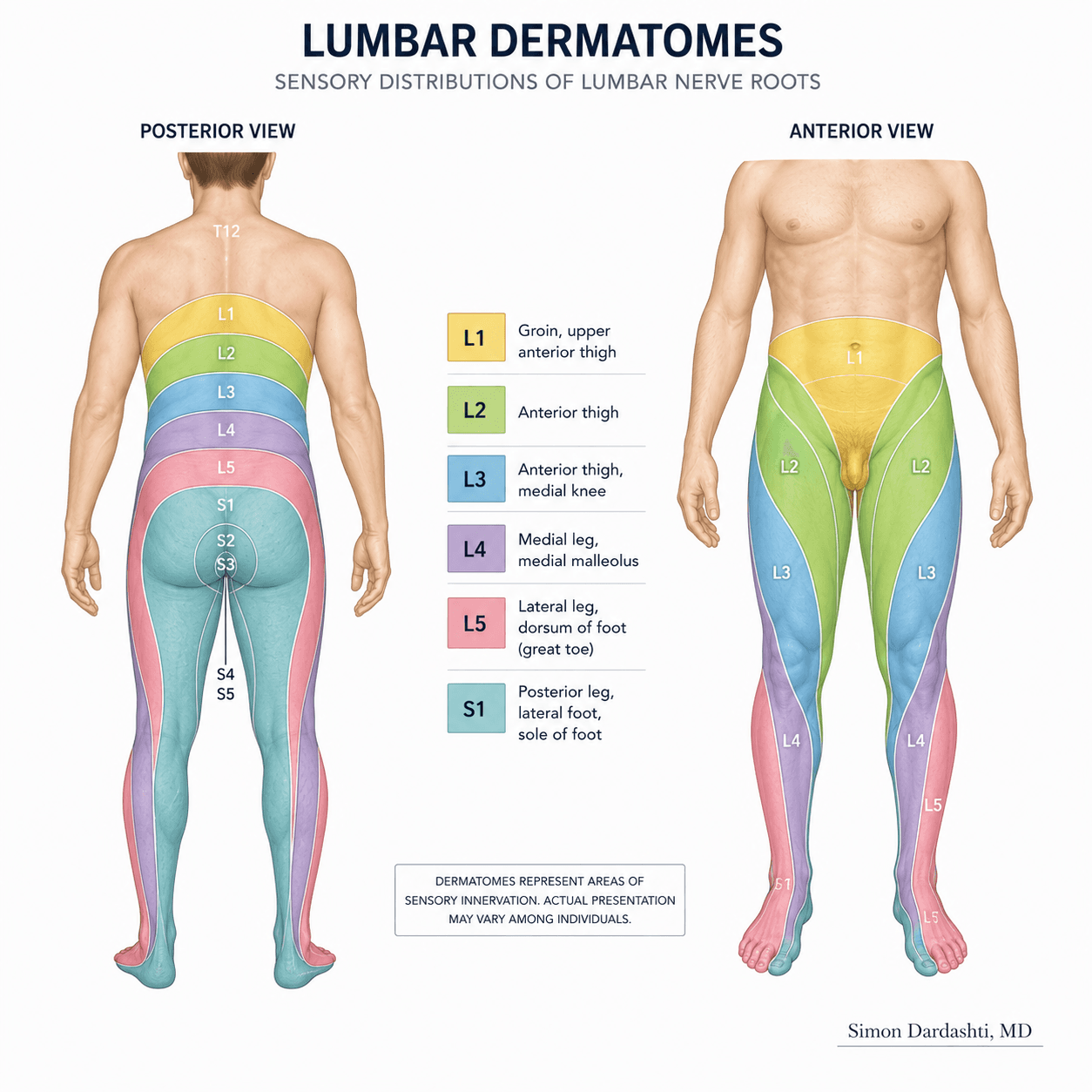
Sciatica commonly refers to pain that radiates from the low back or buttock into the leg, sometimes extending into the foot. The term is often used to describe symptoms that may result from irritation or compression of a lumbar nerve root, though not all leg pain is sciatica. An accurate diagnosis is important because treatment depends on identifying the likely source.
Radicular pain refers more broadly to pain that travels along the path of a nerve root. It can occur in the lumbar spine — causing symptoms into the leg — or in the cervical spine, causing symptoms into the arm. Radiculopathy refers to nerve root dysfunction that may also involve numbness, tingling, or weakness in addition to pain. When symptoms primarily involve the neck with radiation into the arm, that presentation is more specifically addressed under cervical radiculopathy.
Common underlying causes may include herniated intervertebral discs, spinal stenosis, foraminal narrowing, or other conditions that affect the nerve as it exits the spinal column.
Symptoms
Common Symptoms.
Symptoms associated with radicular pain or nerve root irritation may include:
- Radiating pain from the neck into the arm, or from the low back into the leg
- Numbness or tingling along the arm, hand, leg, or foot
- Weakness in the arm, hand, leg, or foot
- Pain that worsens with certain positions, movements, or prolonged sitting or standing
- Shooting or electric-like pain along a nerve distribution
- Symptoms that are worse in one limb than the other
Approach
How Dr. Dardashti Evaluates Radicular Pain.
Evaluation includes a detailed history of symptom onset, character, distribution, and prior treatment response. A neurologic examination assesses reflexes, sensation, and motor strength to help localize the likely nerve root level involved.
When imaging is available — such as MRI of the cervical or lumbar spine — findings are reviewed in the context of the patient's clinical presentation. A herniated disc or foraminal narrowing on imaging does not automatically indicate that a procedure is needed; treatment decisions are based on the full clinical picture.
Treatment
Treatment Options That May Be Considered.
Treatment depends on the severity, duration, and character of symptoms, along with the patient's prior treatment history and clinical examination. Options that may be considered include:
- Conservative care coordination, including physical therapy
- Medication management when clinically appropriate
- Epidural steroid injections for selected patients with nerve-related radicular symptoms
- Selective nerve root blocks for diagnostic or therapeutic consideration
- Cervical or lumbar interlaminar or transforaminal approaches depending on the clinical situation
- Ongoing monitoring and reassessment based on treatment response
Not every patient with radicular pain requires an injection. Treatment recommendations are based on individual clinical evaluation.
Limitations
Important Limitations.
Radicular pain can have multiple contributing causes, and not all cases resolve with any single treatment. Response to treatment varies among patients. An accurate diagnosis based on clinical evaluation is essential before treatment is initiated. This page is for general informational purposes only and does not constitute medical advice or create a physician-patient relationship.
Dr. Dardashti sees patients in Mission Hills, California, serving patients from the San Fernando Valley, Santa Clarita Valley, and surrounding Los Angeles communities.
Medically Reviewed by Simon Dardashti, MD, MS·Board-Certified, Pain Medicine & Anesthesiology
Last Reviewed: July 2026