Mobility & Release
Thoracic Foam
Rolling.
Improving upper back mobility for neck pain, shoulder pain, and posture. Anatomy, technique, and precautions.
Anatomy
Thoracic Spine Anatomy.
The thoracic spine is the middle section of the vertebral column, comprising 12 vertebrae from approximately the shoulder blade level down through the rib cage. Unlike the cervical (neck) spine designed for mobility, the thoracic spine prioritizes stability and serves as attachment points for the ribs.
The thoracic spine has natural curves and is supported by strong ligaments and the rib cage itself. This design provides stability for protecting internal organs but can result in naturally limited mobility compared to other spinal regions.
However, modern posture—particularly excessive sitting and forward head posture—often results in progressive thoracic stiffness beyond the spine's natural characteristics.
Why
Why Thoracic Stiffness Contributes to Pain.
When the thoracic spine becomes stiff, adjacent regions must compensate. The cervical spine (neck) and shoulder joints increase their movement to accommodate tasks that ideally would involve thoracic mobility.
This compensation can lead to or worsen neck pain, shoulder pain, and headaches. The cervical spine and shoulder structures are not optimized for excessive movement—when forced to compensate for thoracic stiffness, they may develop pain.
Improving thoracic mobility may reduce the compensatory stress on the neck and shoulders, potentially decreasing pain.
Benefits
Potential Benefits of Thoracic Foam Rolling.
When performed correctly, thoracic foam rolling may:
- Improve thoracic extension mobility—particularly important for postural balance
- Reduce trigger point tension in thoracic muscles
- Improve posture by reducing forward rounding of the upper back
- Reduce compensatory stress on the neck and shoulders
- Decrease neck pain or shoulder pain related to thoracic stiffness
- Serve as part of a broader approach to upper extremity pain management
Technique
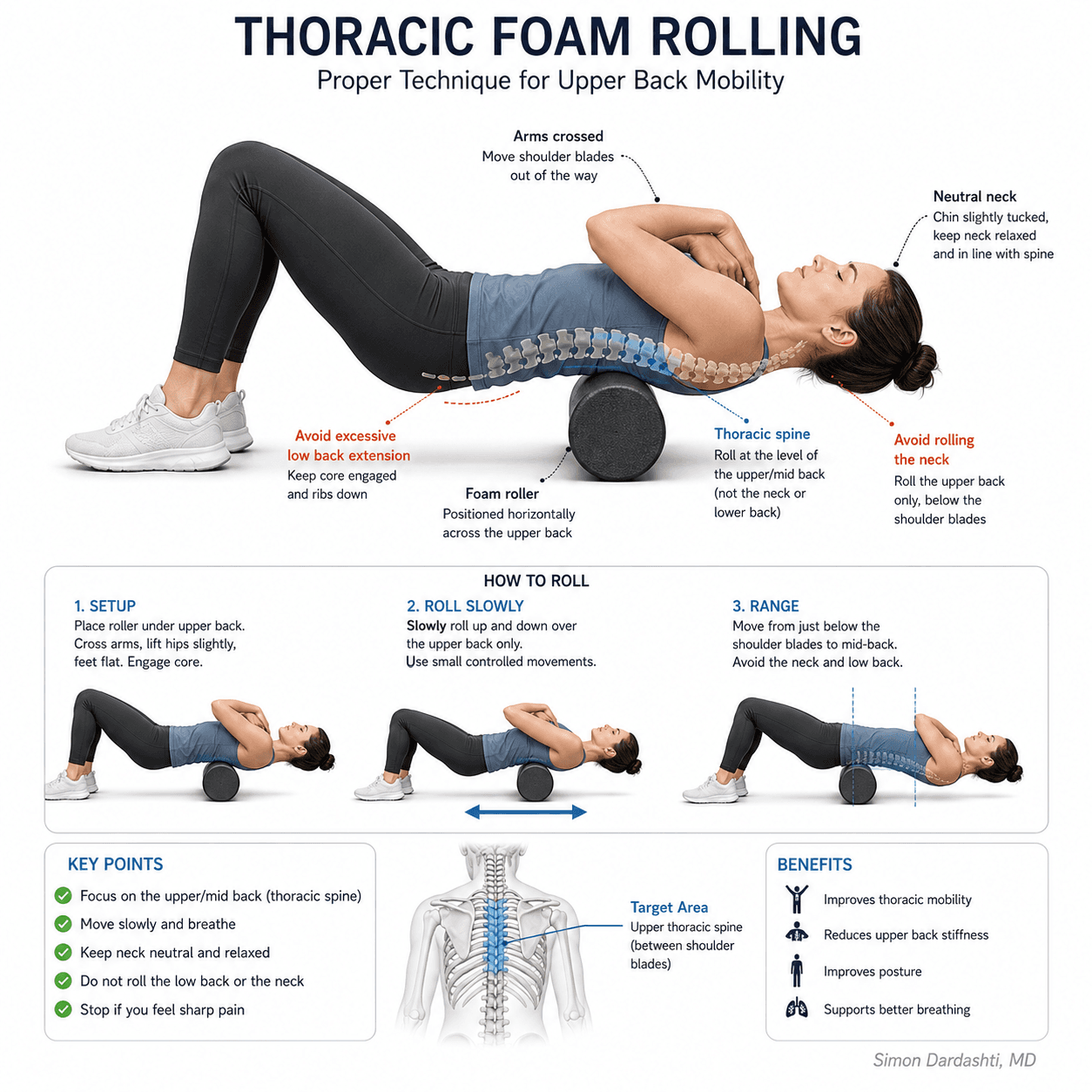
Proper Thoracic Foam Rolling Technique.
Key principles for safe and effective foam rolling:
- Position foam roller horizontally across the thoracic spine (not vertically along the spine)
- Support head and neck with hands to maintain neutral position
- Use legs for control—push gently with feet to roll back and forth slowly
- Roll over the rib cage area; avoid rolling directly over the spine
- Breathe continuously—do not hold your breath
- Start with lighter pressure and progress gradually
- Perform for 30 seconds to 1 minute at a time
- Stop if you experience sharp pain—mild pressure sensation is normal
- Combine with gentle extension stretches (like supported back extension)
Mistakes
Common Mistakes.
Errors that reduce effectiveness or increase risk:
- Rolling along the spine vertically—the foam roller should be horizontal across the spine
- Lack of neck support—neck must be supported by hands to prevent extension strain
- Rolling too aggressively—should be slow, controlled movements with light pressure
- Rolling too quickly—rushing reduces time for tissue response and increases discomfort
- Neglecting breathing—holding breath increases tension and risk
- Ignoring sharp pain—should stop immediately if experiencing sharp pain
- Excessive duration—starting with long sessions; should begin conservatively
- Rolling on bony areas—should target soft tissue of rib cage, not ribs or spinous processes
Contraindications
Contraindications & Safety Considerations.
Thoracic foam rolling may not be appropriate for:
- Osteoporosis or osteopenia—risk of compression fracture
- Recent spine or thoracic surgery—requires surgeon approval for timing
- Acute thoracic or rib injuries
- Severe spinal degeneration or instability
- Acute flare of pain or inflammation
- Pregnancy (consult healthcare provider)
- Any condition causing spinal fragility or elevated fracture risk
A healthcare provider should evaluate your individual situation before starting thoracic foam rolling, particularly if you have any bone density concerns or recent surgery.
Timeline
Expected Timeline for Improvement.
Like other mobility and pain management interventions, the timeline for improvement varies among individuals:
- Immediate effect: Temporary improved sensation of mobility or reduced muscle tension
- Acute: Within days to a few weeks, some patients notice improved posture or reduced neck/shoulder tension
- Short-term: After 2-4 weeks of consistent foam rolling, measurable improvements in thoracic extension mobility
- Medium-term: After 4-8 weeks of consistent practice, some patients report sustained reduction in compensatory neck/shoulder pain
- Long-term: Continuation of practice helps maintain mobility gains; discontinuation typically results in gradual loss of improvements
FAQ
Frequently Asked Questions.
What is the thoracic spine?
The thoracic spine is the middle section of the spine, from approximately shoulder blade level down through the rib cage. It includes 12 vertebrae and is designed for stability rather than extensive mobility.
Why does thoracic stiffness affect neck and shoulder pain?
When the thoracic spine loses mobility, the cervical spine and shoulders must compensate by moving more, creating or worsening pain. Improving thoracic mobility may reduce compensatory stress.
Is thoracic foam rolling safe?
For most people, gentle foam rolling is generally safe when done correctly. However, certain conditions require caution, including osteoporosis or recent surgery. Consult a healthcare provider if concerned.
How often should I foam roll?
Most recommendations suggest a few times per week. Frequency varies based on tolerance and symptoms. Start conservatively and increase gradually if tolerated.
Should foam rolling hurt?
Foam rolling should produce mild pressure, not sharp pain. Mild sensation is normal, but sharp or severe pain indicates you should stop immediately.
Can I foam roll if I have osteoporosis?
Foam rolling carries increased compression fracture risk with osteoporosis. A healthcare provider should evaluate whether it's appropriate for your bone density.
How long until I notice improvement?
Some notice changes within days to weeks of consistent foam rolling. Others require weeks to months. Regular practice and proper technique matter.
Can I foam roll after spine surgery?
Thoracic foam rolling after surgery requires surgeon approval. Timing and restrictions depend on your specific surgery and healing. Always consult your surgeon first.
Is foam rolling a substitute for physical therapy?
No. Foam rolling may complement physical therapy but is not a substitute for professional evaluation and treatment. A PT can determine appropriateness and integration.
Accepting Virtual Consultations
Earlier evaluation for spine, nerve, and joint pain when travel, disability, recent injury, or long wait times make in-person care difficult.
Medically Reviewed by Simon Dardashti, MD, MS·Board-Certified, Pain Medicine & Anesthesiology
Last Reviewed: July 2026