Exercise & Stability
McGill Big 3
Exercises.
Evidence-based exercise approach for spinal stability: curl-ups, side planks, and bird dogs. Who benefits, proper technique, and common mistakes.
Who
Who Was Stuart McGill?
Stuart McGill is a biomechanist and professor emeritus who spent decades researching spinal mechanics, spine loading during movement, and the relationship between exercise, motor control, and back pain. His work emphasized understanding how the spine functions and how to load it appropriately during exercise.
McGill advocated for specific, evidence-informed exercise approaches rather than generalized core strengthening. His research identified key principles for safe spinal exercise.
Why
Why Spinal Stability Matters.
Spinal stability refers to the coordinated action of muscles surrounding the spine—particularly the deep core stabilizers—working to support and control spinal movement. Adequate stability helps manage forces and loads placed on the spine during daily activities.
Poor spinal stability or motor control can contribute to pain or dysfunction. McGill's Big 3 exercises target key muscles involved in stability: the transverse abdominis, multifidus, and quadratus lumborum.
These exercises were designed to build stability without excessive spinal compression or bending forces.
The Three
The Three Exercises.
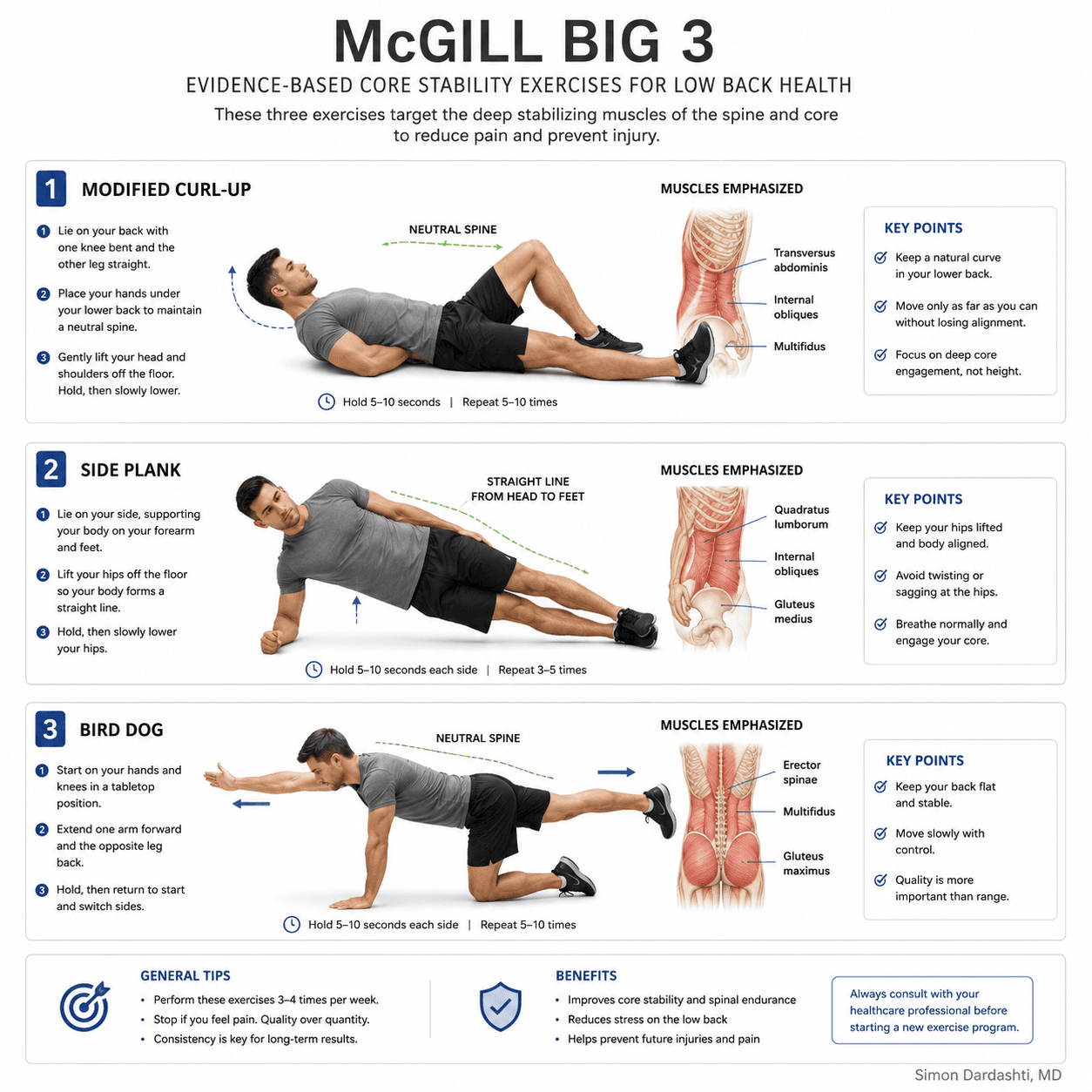
Curl-up
The curl-up targets the rectus abdominis without excessive spinal flexion. Performed by supporting the head with hands and gently raising the shoulders slightly while maintaining a neutral lower spine. The movement is modest and controlled.
Side Plank
The side plank targets the quadratus lumborum and lateral stabilizers. Performed by supporting body weight on the forearm and feet (or knees) in a straight line position. The exercise builds lateral stability without spinal movement.
Bird Dog
The bird dog targets the multifidus and promotes motor control. Performed in quadruped position (hands and knees) by extending opposite arm and leg while maintaining a neutral spine. The exercise emphasizes coordination and control rather than strength.
Technique
Proper Form Matters.
Correct technique is essential. Improper form reduces exercise effectiveness and increases risk of symptom provocation. Key principles include:
- Maintaining a neutral spine position (avoid excessive flexion or extension)
- Controlled movement rather than speed or momentum
- Breathing continuously (avoid holding breath)
- Starting with modest intensity and progressing gradually
- Stopping if exercises provoke sharp pain or radicular symptoms
- Consistency—regular practice matters more than intensity
Mistakes
Common Mistakes.
Common errors that reduce effectiveness or increase risk:
- Excessive spinal flexion or extension—spine should remain neutral
- Rapid or bouncing movements—should be slow and controlled
- Holding breath—continuous breathing is important
- Excessive intensity progression—slow, consistent progress works better
- Poor alignment (sagging or hiking hips in planks)—alignment matters
- Continuing despite pain—sharp pain or radicular symptoms indicate stopping
- Neglecting warm-up or context—exercises should fit within overall activity
Considerations
Contraindications & Cautions.
McGill exercises are not appropriate for all patients. Conditions where caution is warranted include:
- Acute severe radiculopathy with neurological signs
- Spinal stenosis with significant neurological symptoms
- Recent spinal surgery (consult surgeon regarding timing)
- Significant osteoporosis (compression fracture risk)
- Cauda equina syndrome symptoms
- Uncontrolled inflammation or infection
A physical therapist or physician should screen for these conditions before starting McGill exercises.
Personalization
How Physical Therapists Personalize These Exercises.
A physical therapist tailors McGill exercises based on your individual presentation by:
- Modifying starting position (knee bent vs straight, reduced range)
- Adjusting repetitions and sets based on your response
- Progressing intensity gradually as symptoms improve
- Eliminating or modifying exercises if they provoke symptoms
- Adding complementary exercises addressing your specific deficits
- Teaching proper form and correcting technique errors
- Monitoring for signs that exercise should be reduced or stopped
Professional guidance helps ensure exercises remain safe and beneficial for your specific condition.
FAQ
Frequently Asked Questions.
Are these exercises a cure for back pain?
No. McGill exercises are one component of back pain management. They may reduce symptoms and improve function for some patients, but results vary and they must be performed correctly.
Can I do these exercises on my own?
While some learn from videos, professional instruction from a physical therapist ensures correct form, appropriate progression, and identification of unsuitable exercises for your condition.
How often should I do these exercises?
Typical recommendations are daily or several times per week. Your PT will determine appropriate frequency and progression based on your response.
When should I stop doing these exercises?
Stop if exercises cause sharp pain, radicular symptoms, or worsening function. Mild discomfort is different from pain indicating you should stop.
Who should avoid these exercises?
Patients with acute severe radiculopathy, significant stenosis with neurological symptoms, or recent surgery may not be appropriate candidates.
How long before I notice improvement?
Timeline varies. Some notice changes within weeks of consistent practice. Others require months. Consistency and proper technique matter.
Do I need equipment?
No. McGill exercises require only your body weight. A mat or towel for comfort is optional.
What if I have osteoporosis?
Certain positions in McGill exercises (like spinal flexion in curl-ups) may present increased risk. A physical therapist or physician should advise based on your bone density.
Should I do these exercises forever?
Some patients continue these exercises long-term for maintenance. Others progress to more challenging exercises. A PT helps determine the right long-term approach.
Accepting Virtual Consultations
Earlier evaluation for spine, nerve, and joint pain when travel, disability, recent injury, or long wait times make in-person care difficult.
Medically Reviewed by Simon Dardashti, MD, MS·Board-Certified, Pain Medicine & Anesthesiology
Last Reviewed: July 2026