Conditions Evaluated
Eagle Syndrome
Evaluation.
Eagle syndrome is an uncommon cause of throat, neck, facial, and ear pain related to the styloid process or stylohyoid ligament. Dr. Dardashti provides supportive evaluation of pain symptoms that may be associated with this condition as part of a broader differential diagnosis.
In Brief
An Uncommon, Often-Missed Diagnosis
Eagle syndrome is caused by an elongated styloid process or a calcified stylohyoid ligament. Because it is uncommon and its symptoms overlap with several other conditions, it is frequently overlooked or misdiagnosed.
Symptoms That Mimic Other Conditions
Throat, neck, facial, and ear pain associated with Eagle syndrome can resemble cervicogenic headache, TMJ disorders, or nerve-related facial pain, which is why careful evaluation is important.
Imaging-Guided Evaluation
CT imaging can typically identify an elongated styloid process or calcified stylohyoid ligament, helping guide whether further specialist evaluation is appropriate.
Overview
What Is Eagle Syndrome?
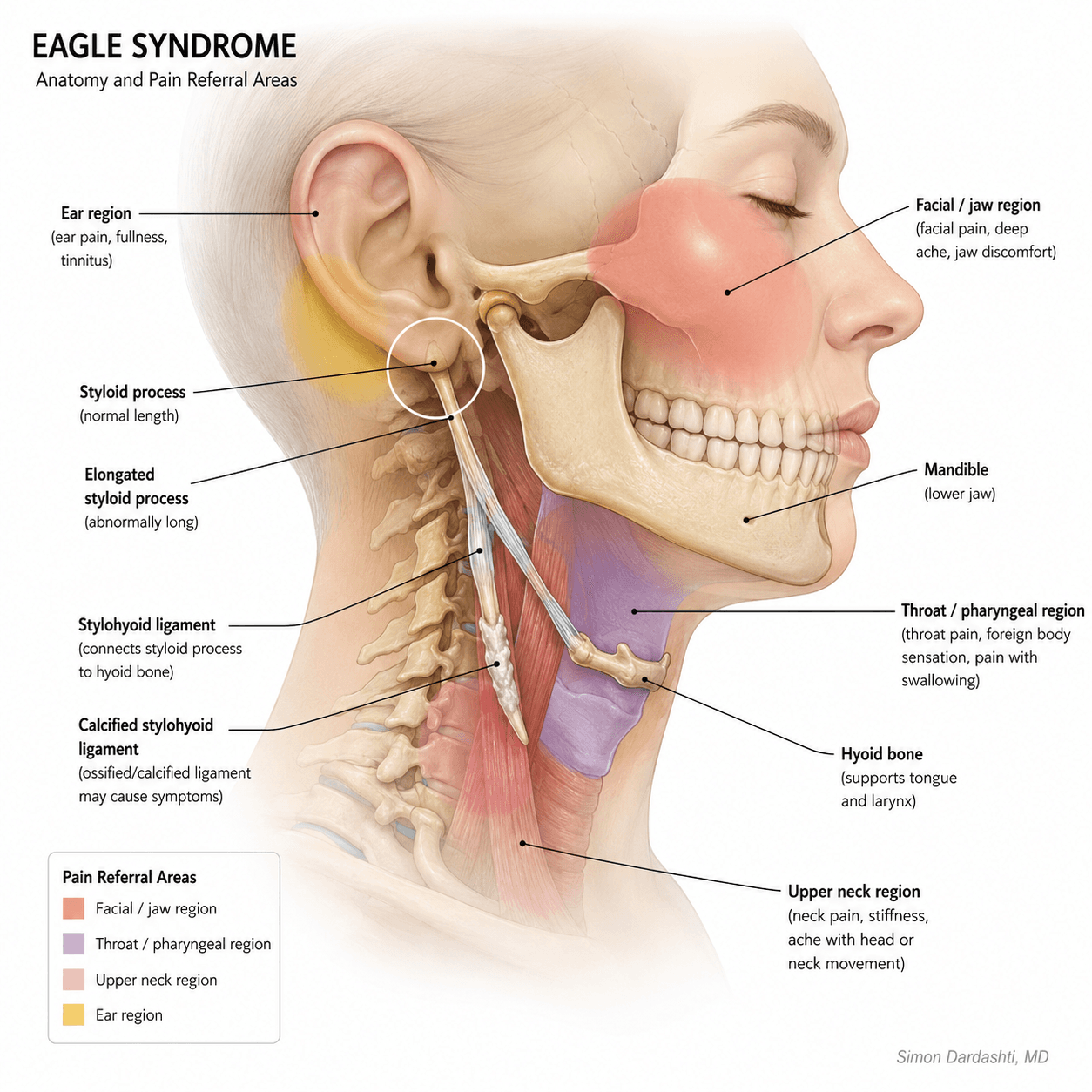
Eagle syndrome is a condition associated with an abnormally elongated styloid process — a small, pointed piece of bone that extends downward from the base of the skull — or calcification of the stylohyoid ligament, which normally connects the styloid process to the hyoid bone in the neck.
When the styloid process is longer than typical, or when the stylohyoid ligament becomes calcified and rigid, these structures can irritate or compress nearby nerves, blood vessels, and soft tissue in the neck and throat. This is believed to be the underlying mechanism behind the pain symptoms associated with the condition.
Eagle syndrome is considered uncommon, and elongated styloid processes are sometimes identified incidentally on imaging in patients without any symptoms. This means that an elongated styloid process alone does not confirm the diagnosis — symptoms, clinical history, and examination findings must be considered together.
Symptoms
Common Symptoms Associated With Eagle Syndrome.
Symptoms that may be associated with Eagle syndrome include:
- Throat pain, often described as a persistent ache or a sensation of a foreign body
- Neck pain, which may be dull or sharp and may worsen with certain head positions
- Facial pain, sometimes affecting one side more than the other
- Ear pain that is not explained by an ear examination
- Pain or discomfort with swallowing
- Pain that worsens with head or neck movement, or with turning the head
These symptoms are not specific to Eagle syndrome and overlap significantly with other conditions. Their presence does not confirm the diagnosis on its own.
Overlap
Why Eagle Syndrome May Mimic Other Conditions.
Because the styloid process and stylohyoid ligament are located near a number of nerves and vascular structures in the neck, symptoms of Eagle syndrome can closely resemble other, more common causes of head, neck, and facial pain — including cervicogenic headache, temporomandibular joint (TMJ) disorders, glossopharyngeal neuralgia, and cervical facet-related pain.
This overlap means that Eagle syndrome is often considered only after other, more common causes of similar symptoms have been evaluated and are not fully explaining the clinical picture. A broad differential diagnosis is an important part of the evaluation process.
Approach
General Evaluation Considerations.
Evaluation typically begins with a detailed history of pain location, character, triggers, and associated symptoms such as pain with swallowing or head movement. Physical examination may include palpation of the tonsillar region and assessment of pain reproduction with specific movements.
Imaging plays an important role in evaluation. CT imaging, in particular, can identify an elongated styloid process or calcified stylohyoid ligament and help correlate anatomical findings with the patient's reported symptoms.
Because Eagle syndrome sits at the intersection of several specialties, evaluation often involves coordination with an ear, nose, and throat (ENT) specialist or an oral-maxillofacial specialist, particularly when structural or surgical management of the styloid process or stylohyoid ligament is being considered.
Role
How Pain Management May Fit Into Evaluation.
Within a broader care team, pain management evaluation may contribute to the workup of suspected Eagle syndrome in the following ways:
- Reviewing pain patterns and history to help distinguish Eagle syndrome from other pain generators
- Supporting differential diagnosis alongside ENT or oral-maxillofacial evaluation
- Discussing non-surgical pain care options when clinically appropriate
- Coordinating with other specialists when structural evaluation or surgical consultation is indicated
Dr. Dardashti's role in suspected Eagle syndrome is one of supportive evaluation and pain-focused care coordination. Definitive structural or surgical management of an elongated styloid process, when indicated, is directed by ENT or oral-maxillofacial specialists.
Limitations
Important Limitations.
Eagle syndrome cannot be diagnosed from imaging findings or symptoms alone, and no single test or examination finding is definitive. This page is for general educational purposes only and does not constitute medical advice, and it does not represent a guarantee that any specific diagnosis will be confirmed or that any particular treatment will be recommended or effective.
A formal clinical evaluation — often involving more than one specialist — is required to determine the likely cause of throat, neck, facial, or ear pain in any individual patient.
Dr. Dardashti sees patients in Mission Hills, California, serving patients from the San Fernando Valley, Santa Clarita Valley, and surrounding Los Angeles communities.
Related
Medically Reviewed by Simon Dardashti, MD, MS·Board-Certified, Pain Medicine & Anesthesiology
Last Reviewed: July 2026