Procedures & Treatment Options
Peripheral Nerve Stimulation
Evaluation.
Peripheral nerve stimulation is an advanced pain management option for selected patients with chronic peripheral nerve pain. A thorough evaluation is required to determine whether peripheral nerve stimulation is appropriate for any individual patient.
In Brief
What it is
An evaluation to determine whether peripheral nerve stimulation (PNS) — an implantable device that delivers electrical stimulation to peripheral nerves — may be appropriate for chronic pain management.
When it may be considered
In selected patients with chronic peripheral nerve pain that has not responded adequately to conservative treatment and other interventional options, after comprehensive clinical evaluation.
What to expect
The evaluation includes a thorough history, physical examination, review of prior treatments, and discussion of potential benefits and limitations. If appropriate, a trial of temporary nerve stimulation may be offered to assess response before considering implantation.
Overview
What Is Peripheral Nerve Stimulation?
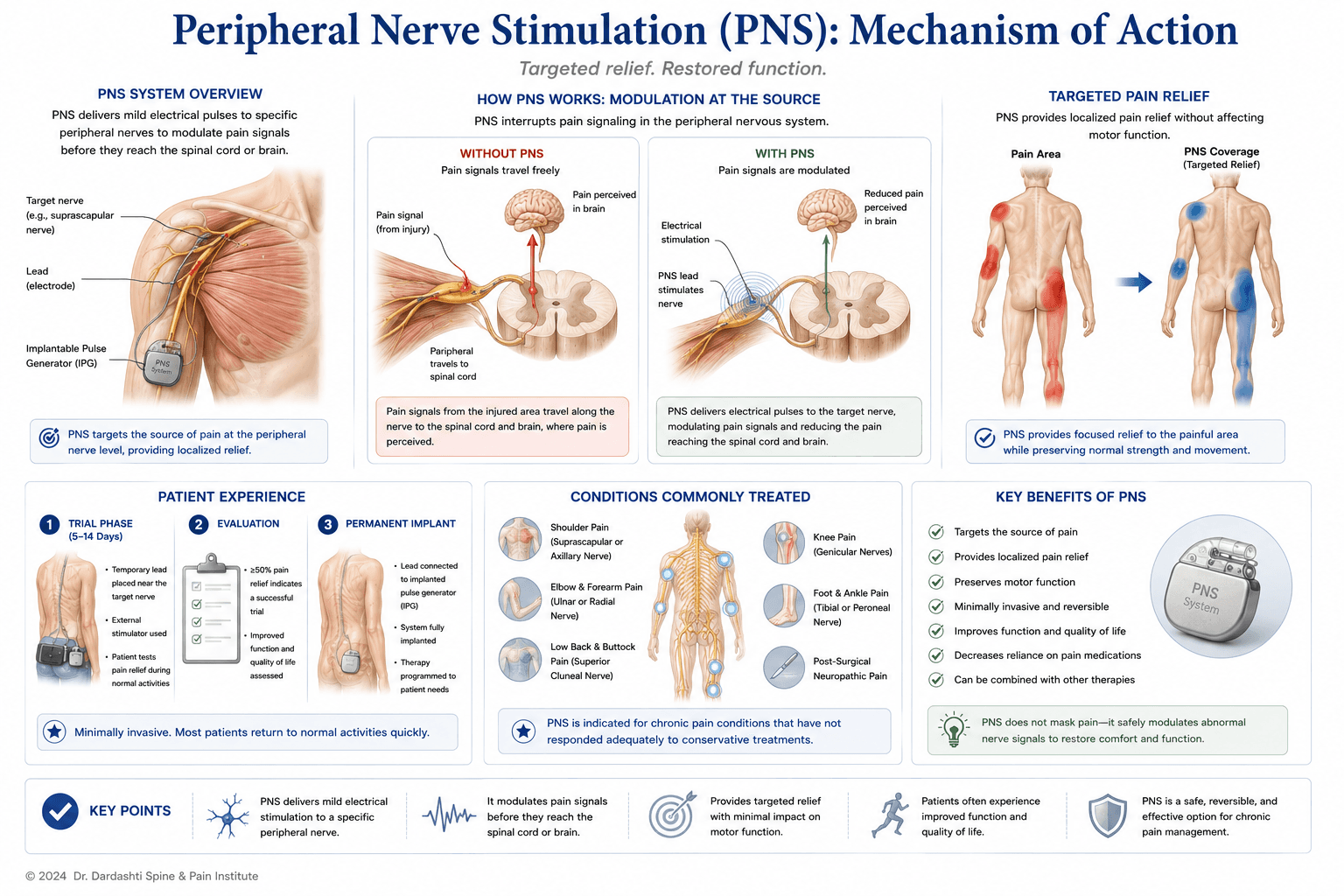
Peripheral nerve stimulation (PNS) is a neuromodulation treatment where an electrode is placed near a peripheral nerve, and a small implantable generator delivers electrical pulses to that nerve. The stimulation is thought to interfere with pain signal transmission or modulate pain perception.
PNS systems consist of an implanted generator (power source) placed under the skin, electrodes that contact the nerve, and a remote control that allows the patient to adjust stimulation parameters. The system can be programmed and adjusted to optimize pain relief for the individual patient.
Indications
When PNS Evaluation May Be Appropriate.
Peripheral nerve stimulation evaluation may be considered for selected patients with:
- Chronic peripheral nerve pain that has not responded to conservative treatment
- Pain in the distribution of a specific peripheral nerve
- Inadequate response to medications and other interventional procedures
- Conditions where other advanced pain management options have been exhausted or are not appropriate
- Strong motivation to pursue advanced pain management and willingness to participate in trial and potential implantation
Comprehensive clinical evaluation is required to determine candidacy for PNS.
Evaluation
The Peripheral Nerve Stimulation Evaluation.
The evaluation begins with a comprehensive history including the character of pain, duration, location, prior treatments, response to medications and prior procedures, and impact on function. Physical examination helps identify the specific nerve(s) responsible for pain.
Imaging and prior diagnostic testing results are reviewed. The physician assesses whether the patient is a candidate for PNS and discusses potential benefits and limitations. If appropriate, a trial may be offered to test whether PNS provides adequate pain relief before considering implantation.
Trial & Implant
Temporary Treatment and Implantation Considerations.
The pathway depends on the specific PNS system. Some systems use a temporary treatment course, while others may use a screening trial before a permanently implanted system is considered. The physician should explain the indication, expected treatment course, response assessment and removal or implantation plan.
A permanently implanted system may be considered when appropriate for the device and clinical situation. Temporary treatment systems instead have their own planned removal pathway. Discuss the specific options, benefits, risks and follow-up with your physician.
Questions
Frequently Asked Questions.
What is peripheral nerve stimulation?
Peripheral nerve stimulation (PNS) is an implantable device-based treatment where a small electrode is placed near the peripheral nerve causing pain, and a small generator delivers electrical stimulation to that nerve. The stimulation may interfere with pain signals or modulate pain perception.
How is peripheral nerve stimulation different from spinal cord stimulation?
Both are neuromodulation treatments using electrical stimulation to address pain. Spinal cord stimulation targets nerves in the spinal cord, while peripheral nerve stimulation targets specific peripheral nerves in the periphery. The choice between them depends on the pain condition and location.
What does a trial consist of?
The process depends on the device. Some systems use a temporary treatment course; others may use a screening trial before a permanently implanted system is considered. A temporary treatment course is not necessarily a trial for permanent implantation.
How is the device controlled?
Controls depend on the system. Some systems use an external generator and others an implanted generator. Your treatment team explains the controls and permitted adjustments for the proposed device.
Is implantation required?
Temporary leads are placed through the skin. Temporary treatment systems and permanently implanted systems have different pathways. Your physician should explain the proposed device, treatment duration and removal or implantation plan; a temporary course does not necessarily lead to a permanent implant.
What are the limitations?
Peripheral nerve stimulation does not cure the underlying condition. Response varies widely and cannot be predicted before trial. The device requires programming and maintenance. Long-term effectiveness data is still developing for many indications.
Information
Important Information.
Peripheral nerve stimulation does not cure the underlying condition causing nerve pain. Response to PNS varies widely and cannot be predicted in advance. Some patients experience significant pain relief while others experience minimal relief. Long-term effectiveness data is still developing for many indications.
Implantation of a PNS system is a surgical procedure carrying surgical risks. The device requires ongoing management including programming, battery monitoring, and potential replacement. Insurance coverage for PNS varies; some plans may not cover the procedure or may have specific coverage criteria.
A comprehensive clinical evaluation is required to determine whether peripheral nerve stimulation evaluation is appropriate for any individual patient. This page is for general informational purposes only and does not constitute medical advice or create a physician-patient relationship.
Dr. Dardashti sees patients in Mission Hills, California, serving patients from the San Fernando Valley, Santa Clarita Valley, and surrounding Los Angeles communities.
Related
Medically Reviewed by Simon Dardashti, MD, MS·Board-Certified, Pain Medicine & Anesthesiology
Last Reviewed: July 2026