Conditions Evaluated
Post-Mastectomy
Pain Syndrome.
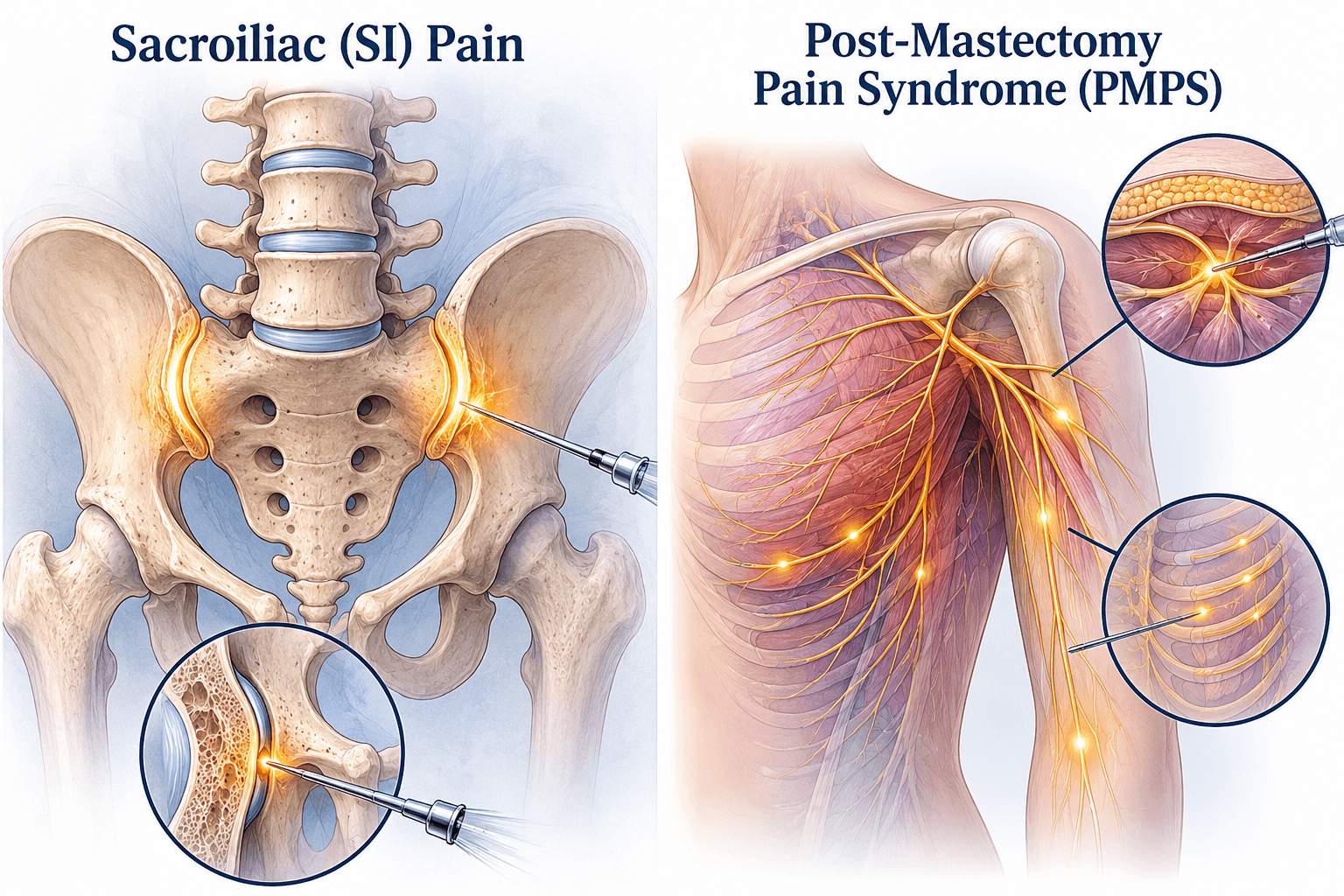
Post-mastectomy pain syndrome (PMPS) refers to persistent pain that can develop in the chest wall, shoulder, axilla, or arm following breast surgery. It is a recognized pain condition that can affect quality of life and may be appropriate for pain medicine evaluation.
In Brief
What it is
Persistent pain in the chest wall, shoulder, armpit, or arm that develops after mastectomy, lumpectomy, or other breast surgery. Often neuropathic in character.
Who may benefit from evaluation
Patients who have completed or are undergoing breast cancer treatment and have persistent pain that has not resolved with standard measures.
Focus of evaluation
Pain characterization, identification of potential anatomical sources, review of prior treatment, and exploration of appropriate pain management options.
Overview
Understanding PMPS.
Post-mastectomy pain syndrome is a term used to describe persistent pain that develops after breast surgery — most commonly mastectomy, but also lumpectomy, axillary lymph node dissection, or reconstruction procedures. It is generally defined as pain lasting beyond three months after the procedure that is not explained by wound healing, infection, or cancer recurrence.
The pain is often described as burning, aching, shooting, or hypersensitive in character. It can involve the chest wall, shoulder, armpit, or the inner upper arm. The pattern and intensity vary between individuals.
PMPS is not rare. Published literature on breast cancer surgery outcomes suggests a meaningful proportion of patients experience some degree of persistent pain following these procedures. For some patients, the pain significantly affects daily function and quality of life.

Mechanisms
Why Pain Can Persist After Breast Surgery.
Several mechanisms may contribute to chronic pain following breast surgery. Nerve injury or irritation during surgery is one of the most commonly discussed factors. The chest wall, axilla, and upper arm are supplied by a network of nerves that can be affected during the surgical process.
The intercostobrachial nerve — a sensory nerve that runs through the axilla and supplies sensation to the inner upper arm and lateral chest wall — is frequently identified as a potential source. Other nerves in the area, including the long thoracic and thoracodorsal nerves, may also be involved depending on the extent of the surgery.
In some patients, tissue changes from radiation therapy or reconstruction may also contribute to ongoing discomfort. The overall picture is often multifactorial, and the exact source of pain may not be fully apparent without evaluation.
Symptoms
Common Symptoms.
Symptoms of PMPS vary, but frequently include one or more of the following:
- Burning, aching, or shooting pain in the chest wall, armpit, or inner arm
- Hypersensitivity to light touch in the affected area
- Pain that persists at rest or is triggered by movement
- Numbness or abnormal sensation along the chest wall or upper arm
- Discomfort with shoulder movement or reaching
- Pain that may be present on the same side as surgery or bilaterally in some cases
These symptoms should always be evaluated in collaboration with the oncology team to rule out other causes before attributing them to PMPS.
Evaluation
Pain Medicine Evaluation.
A pain medicine evaluation for PMPS focuses on understanding the nature and distribution of the patient's pain, identifying which structures may be contributing, and reviewing what has been tried previously.
This includes a detailed pain history (onset, character, distribution, aggravating and relieving factors), physical examination including sensory testing, review of operative and treatment records when available, and discussion of functional impact. Imaging may be reviewed if relevant.
The evaluation does not overlap with oncology care. It is specifically focused on the pain problem and on identifying what pain management options may be appropriate for the individual patient.
Treatment
Treatment Options That May Be Considered.
Treatment for PMPS is individualized and often multimodal. The approach depends on the patient's specific pain pattern, overall health, prior treatment history, and goals. Not every option is appropriate for every patient.
Medications
Neuropathic pain medications or topical agents may help reduce discomfort in selected patients. Options are individualized based on clinical profile, other medical conditions, and tolerability.
Physical therapy
Coordination with physical therapy may address shoulder or chest wall mobility limitations and soft tissue contributors to ongoing pain.
Targeted nerve blocks
In appropriate patients, image-guided or ultrasound-guided nerve blocks targeting specific nerves in the axilla, chest wall, or intercostal region may help reduce pain or clarify the pain source.
Neuromodulation
Published cancer pain literature describes stepwise approaches that may include neuromodulation in carefully selected patients with refractory pain. This is not a routine recommendation.
Procedures
Targeted Nerve Blocks for PMPS.
In appropriate patients with PMPS, targeted nerve blocks may be considered as part of a broader treatment plan. These injections deliver local anesthetic — and sometimes a corticosteroid — near specific nerves believed to be contributing to the pain.
The approach depends on the patient's specific pain distribution and the nerves most likely involved. Blocks may be performed under ultrasound or image guidance. Options that may be evaluated in selected patients include:
- Intercostobrachial nerve block — for axillary or inner arm pain following breast surgery
- Intercostal nerve blocks — for chest wall pain in the distribution of affected intercostal nerves
- Serratus anterior plane block — a regional approach that may address lateral chest wall pain
- Pectoral nerve block (PECS) — a regional approach sometimes considered for anterior chest wall pain in appropriate patients
- Paravertebral block — when pain has a thoracic dermatomal distribution, in selected patients
- Stellate ganglion block — considered in carefully selected patients when sympathetically maintained pain is a possible component
Nerve blocks are not a cure for PMPS. In some patients, they can reduce pain temporarily and help identify which nerves are involved. This information can inform decisions about further treatment. Not every patient is a candidate for every block, and results vary between individuals.
Advanced
Advanced Options for Refractory Cases.
For patients whose pain has not responded to conservative measures or nerve blocks, additional options may be considered. Published cancer pain literature describes stepwise approaches that may include targeted nerve blocks and, in selected refractory cases, neuromodulation.
Spinal cord stimulation and peripheral nerve stimulation are among the neuromodulation options that may be evaluated in appropriate patients. These are complex decisions made collaboratively with the patient and, when relevant, in coordination with the oncology team.
In limited circumstances — particularly in the context of refractory cancer-related pain — intrathecal therapy may be considered as an advanced option. This is not a typical first- or second-line approach for PMPS and would require careful multidisciplinary evaluation.
Evaluation for any advanced option does not imply that a procedure will be recommended. A full clinical assessment determines whether a patient is an appropriate candidate.
Care
Coordinated Care After Breast Cancer Treatment.
Managing pain after breast cancer treatment involves more than one specialty. Pain medicine focuses on characterizing and treating the pain itself — not on cancer surveillance or oncology decision-making. These areas of care are complementary.
Patients seeking pain medicine evaluation for PMPS should continue their oncology follow-up as scheduled. Any new or concerning symptoms should be brought to the oncologist's attention promptly, separate from the pain management evaluation.
Physical therapy, psychology support, and other disciplines may also play a role in the overall management of PMPS depending on the patient's needs and goals.
FAQ
Is PMPS different from cancer recurrence?
PMPS is a pain condition related to the surgery and its effects on nerves and surrounding tissue — not a sign that cancer has returned. That said, any new or changing symptoms following breast cancer treatment should be reported to the oncology team for appropriate evaluation before focusing solely on pain management.
How long after surgery can PMPS develop?
PMPS can begin shortly after surgery or emerge months later. It is generally defined as pain that persists beyond three months after the procedure and is not related to wound healing or a new medical issue. The timing varies between individuals.
Can PMPS improve on its own?
For some patients, symptoms improve over time without intervention. For others, pain persists or becomes more disruptive. Early evaluation can help identify whether treatment options may be appropriate and prevent the development of more entrenched pain patterns.
What does evaluation involve?
Evaluation includes a detailed pain history, review of prior treatment and surgical records when available, physical examination, and consideration of whether imaging or other assessments are needed. The goal is to characterize the pain and identify which anatomical structures may be involved.
What treatment options may be considered?
Treatment options depend on the clinical picture. They may include medications, targeted nerve blocks, physical therapy coordination, and in selected cases with refractory pain, neuromodulation. Not every patient requires procedural intervention, and options are discussed individually.
Can nerve blocks cure PMPS?
No. Nerve blocks are not a cure for PMPS. In appropriate patients, targeted nerve blocks may reduce pain temporarily and help clarify which nerves are involved. This information can help guide a broader treatment plan. Results vary and cannot be predicted in advance.
Should I coordinate with my oncologist?
Yes. Pain management after breast cancer treatment should be coordinated with the oncology team. The pain medicine evaluation focuses specifically on pain — not on cancer surveillance or treatment. Both areas of care can proceed in parallel.
Limitations
Important Limitations.
This page is intended for general informational purposes only. It does not constitute medical advice and does not represent the clinical management guidelines of any institution. Not every patient with post-mastectomy pain syndrome is a candidate for interventional procedures. Treatment decisions are individualized and require formal clinical evaluation. Response to any treatment varies and cannot be predicted in advance.
Pain medicine evaluation for PMPS does not replace oncology care. Patients should maintain their oncology follow-up as recommended. Any new symptoms should be discussed with the oncology team promptly.
Dr. Dardashti sees patients in Mission Hills, California, serving the San Fernando Valley, Santa Clarita Valley, and surrounding Los Angeles communities.
Related
Related Conditions & Procedures.
Medically Reviewed by Simon Dardashti, MD, MS·Board-Certified, Pain Medicine & Anesthesiology
Last Reviewed: July 2026