Procedures & Treatment Options
Platelet-Rich Plasma
(PRP) Injections.
Platelet-rich plasma (PRP) is an autologous treatment option — meaning it uses the patient's own blood — that may be considered for selected musculoskeletal pain conditions. A formal clinical evaluation is needed to determine whether PRP is appropriate for any individual patient.
In Brief
What it is
An injection therapy using a concentration of platelets from the patient's own blood, considered for selected musculoskeletal pain conditions after clinical evaluation.
When it may be considered
In selected patients with certain tendon, joint, or soft-tissue pain when other conservative or interventional options have been tried and clinical evaluation supports its use.
What to expect
Blood is drawn, processed to concentrate platelets, and the resulting PRP solution is injected into the affected area. The procedure typically takes 30-60 minutes. Patients are observed briefly and usually go home the same day.
Overview
What Is Platelet-Rich Plasma?
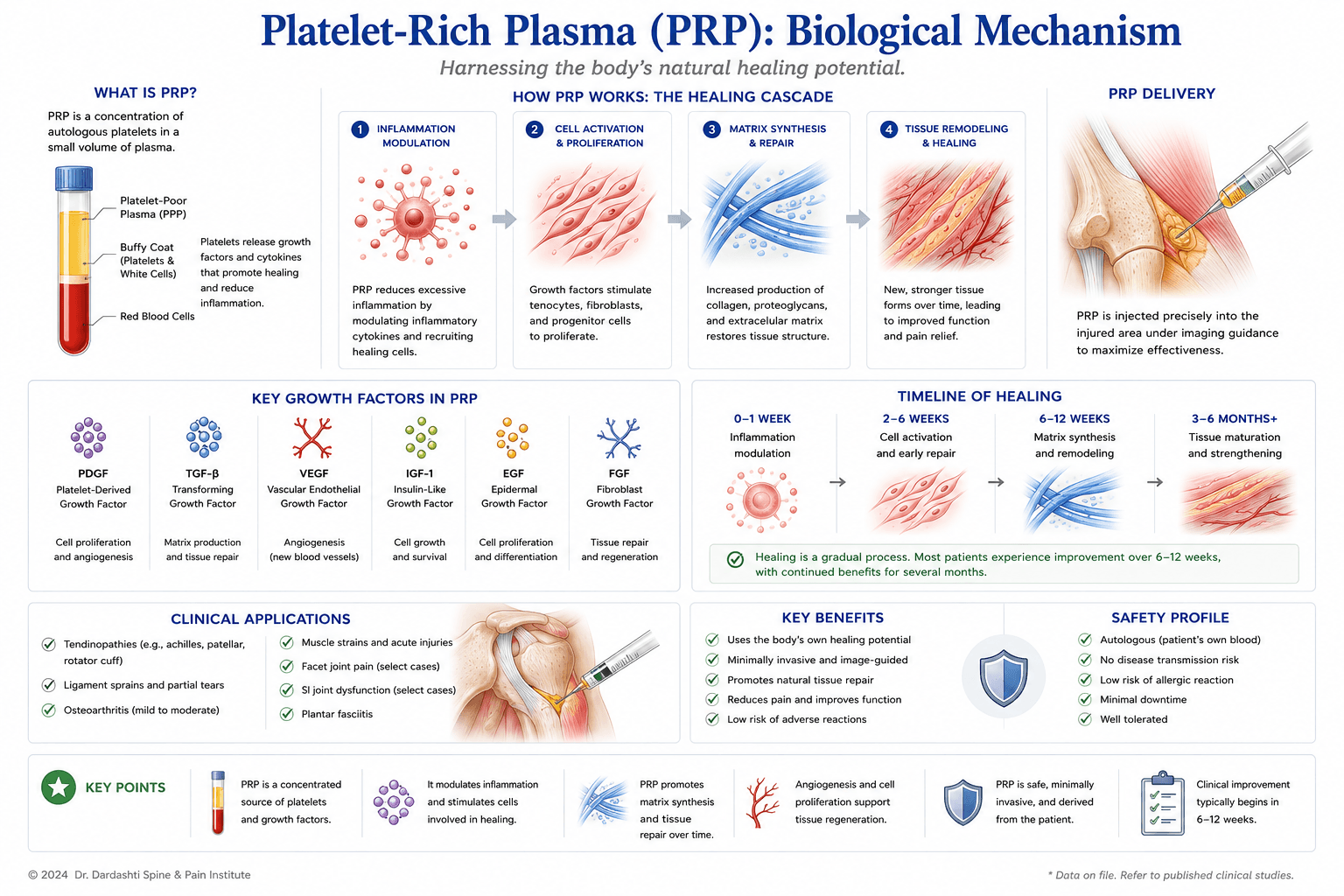
Platelet-rich plasma (PRP) is prepared from the patient's own blood. Blood is drawn, then processed — typically using centrifugation — to concentrate the platelets in a smaller volume of plasma. This concentrated PRP solution contains platelets and other blood components that include various growth factors and bioactive molecules.
When clinically appropriate, the PRP is injected into a targeted area where pain or injury is present. The biological effects of PRP are not fully understood and may vary depending on the specific condition, how the PRP is prepared, and individual patient factors.
Conditions
When PRP May Be Considered.
PRP may be considered for selected musculoskeletal pain conditions, potentially including:
- Tendon-related pain conditions
- Selected joint pain or osteoarthritic changes
- Ligament or soft-tissue injury-related pain
- Selected overuse or degenerative musculoskeletal conditions
PRP is not appropriate for all musculoskeletal pain conditions. Whether PRP may be considered depends on the specific diagnosis, the patient's examination findings, imaging when available, prior treatment response, medical history, and overall clinical context.
Approach
Treatment Planning and Evaluation.
PRP is typically considered after review of the patient's symptoms, physical examination, imaging findings, prior treatments (including conservative care, physical therapy, and medications), and overall clinical goals. PRP is generally not considered a first-line treatment, but rather an option to evaluate when other approaches have been tried or when the clinical picture suggests it may be worth considering.
The goal of evaluation is to determine whether PRP is a reasonable option for the specific patient's condition, based on the overall clinical picture and available evidence for that particular indication.
Evidence
Evidence and Individual Variability.
The scientific evidence for PRP varies significantly by condition and indication. Some conditions have more robust evidence, while evidence for others is still developing. Response to PRP is highly variable between patients and cannot be predicted in advance.
Factors that influence response may include the severity and chronicity of the condition, the specific area being treated, how the PRP is prepared, patient age and overall health, whether other treatments are being used concurrently, and other individual factors. Because of this variability, PRP is not a guaranteed treatment and is not appropriate for every patient or every condition.
Questions
Frequently Asked Questions.
What is the difference between PRP and stem cell therapy?
PRP and stem cell therapy are different treatments. PRP uses concentrated platelets from the patient's own blood. Stem cell therapy uses stem cells, which are different cell types with different properties. Dr. Dardashti evaluates which option, if any, may be appropriate based on the individual patient's diagnosis and clinical picture.
Does PRP cause tissue to heal or regenerate?
While PRP contains growth factors and other bioactive molecules that may influence tissue response, the evidence for tissue regeneration or healing varies by condition and indication. PRP is not a guaranteed regenerative treatment. The actual biological effects and clinical outcomes depend on many factors and cannot be predicted in advance.
Is PRP covered by insurance?
Insurance coverage for PRP varies widely and depends on the insurance plan, the specific indication, and whether the procedure is considered experimental or investigational for that indication. Patients should check with their insurance provider before proceeding.
What are the risks of PRP injection?
Like all injections, PRP injections carry potential risks, including temporary increased pain, bleeding, infection, or allergic reaction. The risks are generally considered low for PRP injections performed under appropriate conditions, but any intervention carries some risk. Risks and benefits are discussed before the procedure.
How quickly will I feel results?
Response to PRP varies considerably. Some patients report pain improvement within days or weeks, while others may take longer or may not experience significant benefit. The timeline and degree of response depend on the condition being treated, severity, chronicity, patient factors, and other treatments being used.
How many PRP injections will I need?
The number of injections recommended depends on the specific condition, prior response, and clinical evaluation. Some patients may benefit from one injection, while others may be candidates for multiple injections spaced over time. This is determined during the clinical evaluation and treatment planning process.
Information
Important Information.
PRP is not appropriate for every patient or every musculoskeletal pain condition. Evidence for PRP's effectiveness varies by condition and indication. Response to treatment is highly variable and cannot be predicted in advance. Insurance coverage for PRP varies; some plans may consider it experimental or investigational for certain indications.
A formal clinical evaluation is required to determine whether PRP is an appropriate option for any individual patient. This page is for general informational purposes only and does not constitute medical advice or create a physician-patient relationship.
Dr. Dardashti sees patients in Mission Hills, California, serving patients from the San Fernando Valley, Santa Clarita Valley, and surrounding Los Angeles communities.
Related
Other Treatment Options.
Medically Reviewed by Simon Dardashti, MD, MS·Board-Certified, Pain Medicine & Anesthesiology
Last Reviewed: July 2026