Patient Comfort Guide
Anxious About an MRI?
You have options.
MRI anxiety and claustrophobia are common. Knowing what the scanner does, what you will hear, and which comfort options to request can make the experience feel more predictable and manageable.
No ionizing radiation
MRI uses a strong magnet and radio waves—not x-rays or CT radiation.
You stay in contact
The technologist can see, hear, and speak with you throughout the exam.
Preparation can help
Sound reduction, an eye covering, positioning, and scanner choice may improve comfort.
The basics
What is an MRI?
Magnetic resonance imaging, or MRI, uses a powerful magnet, radio waves, and a computer to create detailed pictures of structures inside the body. Unlike an x-ray or CT scan, an MRI does not use ionizing radiation.
The scan itself is generally painless, but you must remain still while the images are being made. You will hear repeated tapping, knocking, or thumping. These sounds are expected and come from the scanner operating—not from anything touching or harming you.
MRI is considered very safe for most people when proper screening and facility protocols are followed. Because the magnet is powerful, tell the imaging team about implanted devices, prior surgery, metal or fragments in your body, pregnancy, kidney problems, and any previous contrast reaction. The imaging center—not this website—must determine whether your specific exam and equipment are appropriate.
You are not locked inside. Standard scanners are open at both ends. The technologist monitors you, communicates through an intercom, and can move the table out if necessary.
Scanner options
Standard, wide-bore, and open MRI
The best scanner is the one that can produce the images your medical question requires while helping you complete the exam. Ask the ordering clinician and imaging center what is available and appropriate.
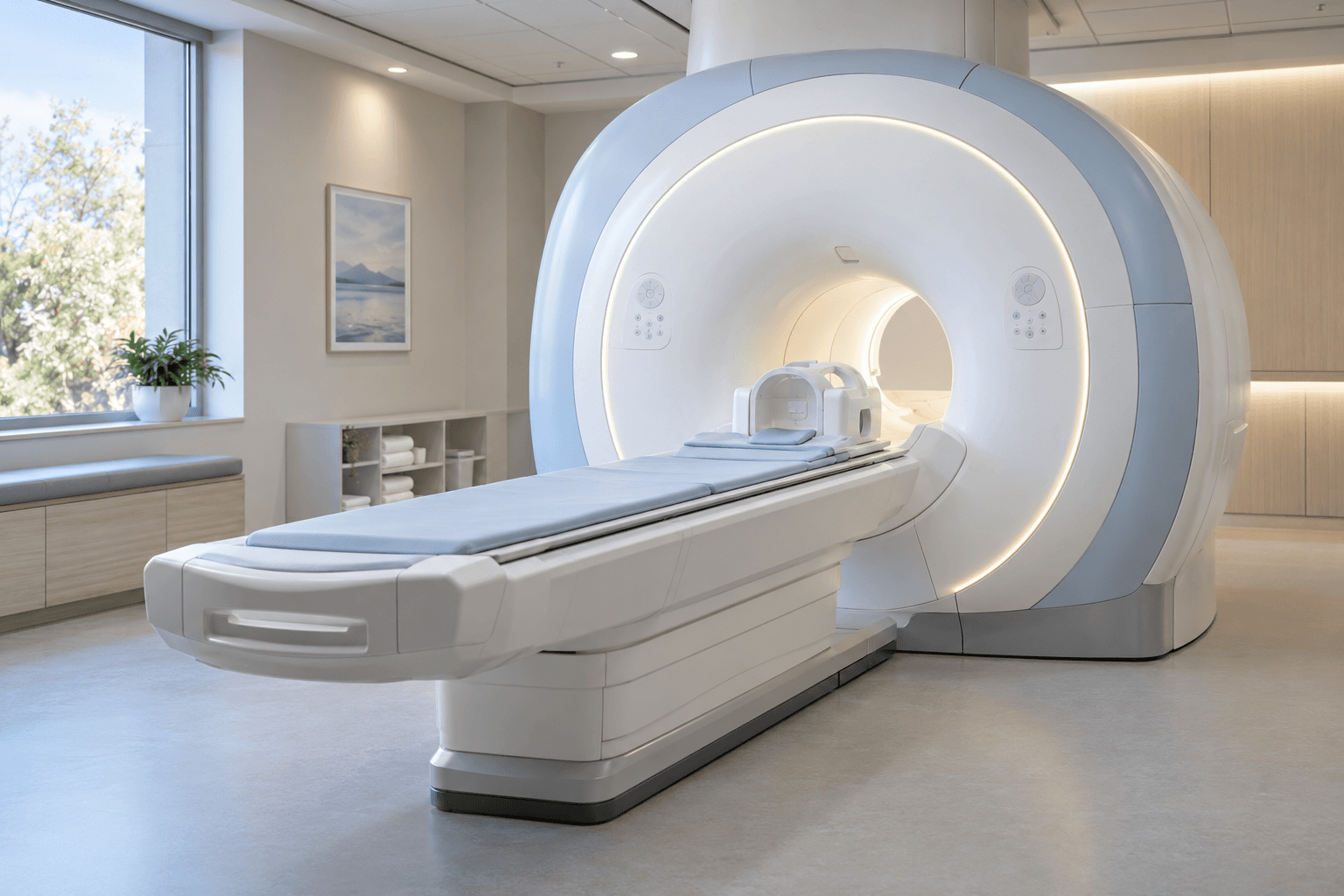
Standard or wide-bore MRI
A standard MRI has a short cylindrical tunnel. Newer wide-bore scanners have a larger opening and may feel less confining while preserving the capabilities needed for many studies.
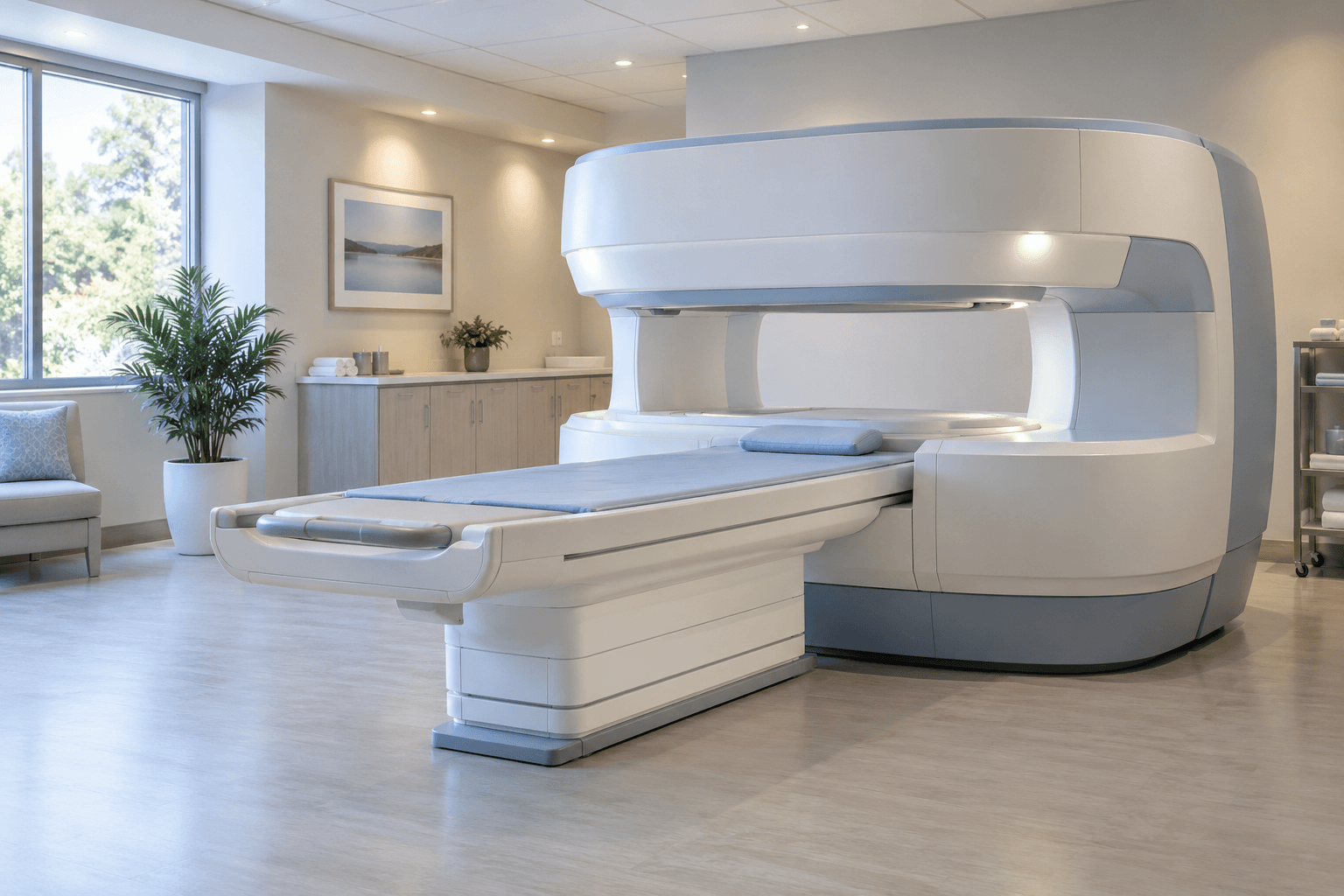
Open MRI
Open MRI systems have more open space around the table and can help some people with severe claustrophobia. They are not available or suitable for every exam, and image quality or scan time may differ by machine and body part.
Original illustrative images created for patient education. Scanner designs and room layouts vary by facility.
Your comfort plan
Six things to ask about before the appointment
Not every imaging center offers every option. Call ahead rather than waiting until you arrive.
01
Tell the imaging center early
When you schedule, say that you have anxiety or claustrophobia. This gives the team time to discuss the scanner, positioning, appointment length, and available accommodations.
02
Reduce the sound
MRI scanners make loud tapping, knocking, and thumping sounds. The imaging team should provide hearing protection such as earplugs, headphones, or both. Some centers can also play music.
03
Limit what you see
Closing your eyes before the table moves, using an MRI-safe eye covering, or asking whether a mirror is available can reduce the visual sense of enclosure. Confirm that anything brought into the room is approved and contains no metal.
04
Stay connected
The technologist can see, hear, and speak with you. Ask whether they can tell you how long each image sequence will last. You will usually have a call or squeeze device if you need attention.
05
Ask about positioning and support
Depending on the body part being imaged, feet-first positioning may be possible. Some facilities also allow a screened support person in the room. Availability and safety rules vary.
06
Practice one simple calming skill
Slow breathing, counting, or focusing on music can give your attention a predictable task. Practice before the appointment so the technique feels familiar rather than new.
Medication
When comfort measures are not enough
In selected circumstances, a clinician may prescribe an oral anxiety medication or arrange sedation to help a patient complete an MRI. This is not necessary for most people and must be planned in advance.
Contact the clinician who ordered the MRI and the imaging center before the appointment. Take medication only if it was prescribed for you and only as directed. Facility policies differ, and medication can interact with alcohol, opioids, sleep medicines, and other sedating drugs.
If medication or sedation is used, you may need a responsible adult to drive you home and may be told not to drive, work, sign important documents, or make major decisions for a period of time. Follow the prescriber's and imaging center's exact instructions.
A simple script for calling the imaging center
“I am concerned about anxiety or claustrophobia during my MRI. Which scanner will be used, how long will my exam take, and what comfort options do you offer? Is a wide-bore or open MRI appropriate for this study? If I may need medication, who should I contact and what transportation rules should I follow?”
Before you arrive
- Complete the facility's safety screening honestly.
- Ask how long your specific exam is expected to take.
- Confirm whether contrast is planned and whether special preparation is needed.
- Arrange transportation if your care team says medication or sedation will be used.
When you check in
- Remind the technologist about your anxiety.
- Ask for properly fitted hearing protection.
- Confirm how you will communicate during the scan.
- Ask to review the plan before the table moves.
Common questions
Does an MRI expose me to radiation?
No. MRI does not use ionizing radiation. It uses a magnetic field and radio waves to create images.
Will my whole body be inside?
That depends on the body part being imaged, the scanner, and positioning. Ask whether feet-first positioning is possible for your exam.
Can I stop if I panic?
Tell the technologist immediately. You can communicate during the scan, and the table can be moved out. Stopping may mean images need to be repeated or the exam rescheduled, so discussing anxiety beforehand is helpful.
Is an open MRI always better?
No. It may feel more comfortable, but it is not the best or available option for every body part or clinical question. A standard wide-bore scanner may be another useful option.
About the author
Simon Dardashti, MD, MS
Dr. Dardashti is board-certified in Pain Medicine and Anesthesiology. This guide is intended to help patients prepare for conversations with the clinician who ordered their MRI and the imaging center performing it.
Authoritative patient resources
- RadiologyInfo.org: How to Prepare for an MRI Exam
- RadiologyInfo.org: MRI Safety
- NHS: MRI Scan
- Mayo Clinic: MRI
Educational information only. Your ordering clinician and imaging center should provide instructions specific to your health, implanted devices, medications, and planned examination.